


Written by Stella Juventia and Hilde Faber
There is no silver bullet for a sudden increase in yield and sustainability, and this holds true for strip cropping. The practice adds complexity to farm management, so why are frontrunner farmers doing it? How do these farmers make decisions when transitioning from monoculture to strip cropping?
A recent study published in PLOS One looks at ten Dutch farmers who are experimenting with strip cropping. The researchers asked those questions, and the answers reveal both the promise and the reality of strip cropping in practice
What does strip cropping look like in practice?
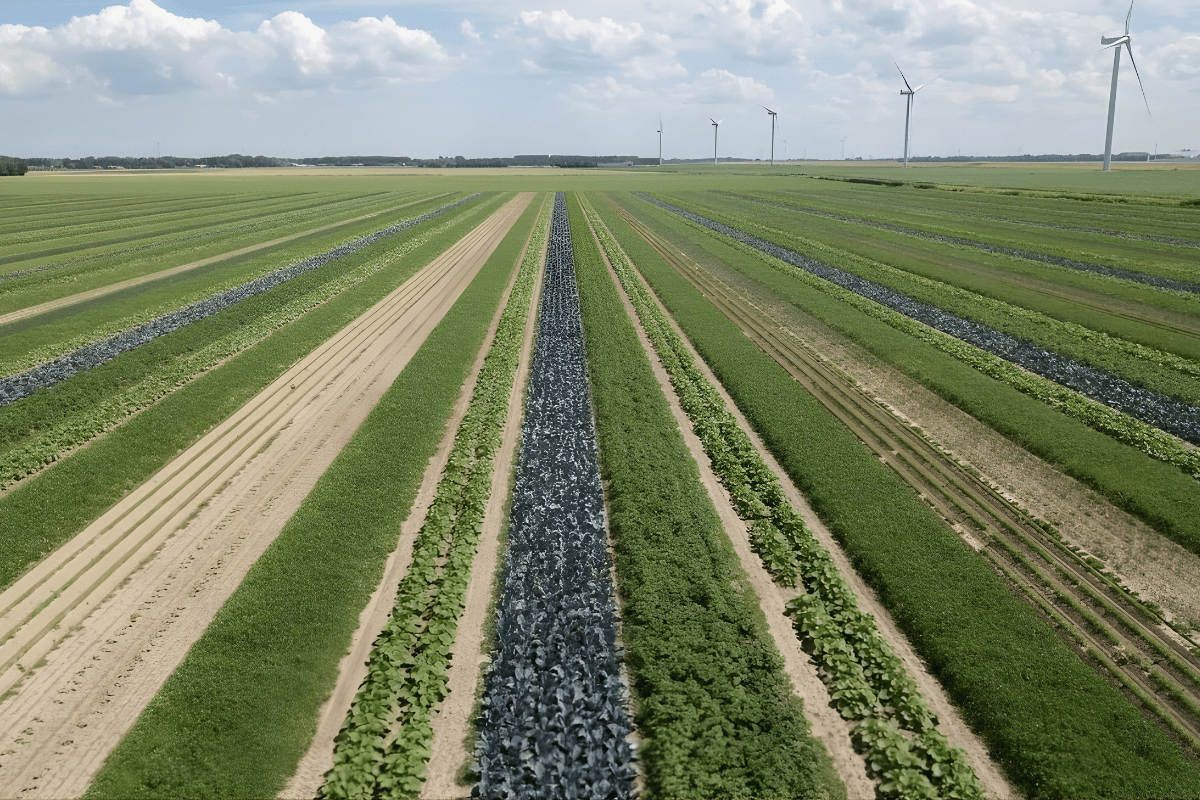
Strip cropping means dividing a large field into smaller, long strips, each planted with a different crop. Think cereals next to legumes, or potatoes next to broccoli, rather than one giant potato field that turns into bare soil after harvest.
Unlike intercropping (where crops are mixed within the same row), strip cropping still allows mechanized farming. Tractors, sprayers, and harvesters can still operate, though not always without adjustment. The farmers in the study typically used strip widths that matched their machinery, often between 3 and 12 meters wide, depending on the crop and equipment.
Why farmers are applying strip cropping
The strongest motivation was not higher yields, as researchers might have hypothesized. The interviewed farmers reported that strip cropping did not always mean higher yields, but it did not decrease them either
Every farmer interviewed said increasing insect biodiversity was a main reason for switching to strip cropping. Other key motivations included improving soil quality, increasing natural enemies of pests, and being an example for other farmers.
For some farmers, strip cropping serves as a stepping stone to applying more diversified systems. These might include agroforestry, crop-livestock integration, pixel cropping, or circle farming as they move toward more sustainable food production.
The reality: it's usually more work, especially in the beginning
None of the farmers claimed strip cropping was easy to implement. One of the biggest challenges they reported was the steep learning curve. Working with strip cropping requires a shift from the monocultural mindset.
Planning complexity
The transition involves meticulous planning of crop choice, including layouts in time (through crop rotation) and space (determining which crops neighbor which). Management also requires more thought than monoculture. How do you spray or irrigate without damaging neighboring strips? There is no handbook yet, so the frontrunners learned by trial and error during this "transition-in-the-making" process.
Machinery challenges
Modern machinery is designed for uniform fields. Strip cropping breaks that uniformity. While some farmers chose to modify existing equipment, others chose to rent or buy new machines that match their strip width. When neither option was feasible, some farmers accepted inefficiencies or even damage to neighboring crops.
Growing crops next to each other can indeed cause problems. Examples provided included cereals that caught fire when neighboring potatoes were burned for late blight control, challenges in harvesting parsnip when the tipper cannot drive over neighboring broccoli still growing, and inefficiency in irrigating cabbage when neighboring cereal was about to be harvested. These crop neighbor issues forced farmers to puzzle with management timing and crop combinations, trying to find pairings that are not only beneficial for agroecological reasons but also feasible in terms of management.
Workload considerations
Workload was reported to increase by most farmers. This is logical, as more planning, more field passes, and adaptation in management were required. Despite the challenges during the transition phase, farmers generally felt the system showed promise and was worth continuing to explore. With growing experience, certain farms have shown that it is possible to create a strip cropping system that results in higher insect diversity or in higher yield and revenue without a significant increase in workload.
How farmers make decisions when transitioning
Decision-making can be expressed in terms of "if–then" rules. For example: if machinery does not fit the strip width, then adapt the strip width or the machine. If biodiversity is the main objective, then choose crops that support insects. If workload becomes too high, then simplify crop choices. The study identified 49 different decision rules and found that farmers generally fell into two tendencies that differed in their machine orientation.
Less machine-oriented farmers tended to work with their current machines without adjusting, renting, or buying new ones, even if it resulted in lower efficiency or damage on neighboring crops.
More machine-oriented farmers, in addition to buying, renting, or adjusting their machines to their chosen strip cropping system, also considered other agroecological options. These included using cover crops to reduce compaction while driving, fitting their envisioned farming system into the strip cropping conditions.
Neither approach was "better," but recognizing the difference matters when considering an entry point for aspiring strip cropping farmers.
What can other farmers learn?
The main takeaway is that there is no single blueprint for strip cropping. What works depends on the farm context, farmer objectives, constraints, education, and management preferences.
Consider these factors if you plan to work with strip cropping systems:
- Crop neighbor effects and compatibility
- Crop choice and rotation planning
- Machine investment and adaptation needs
- Start small, be willing to experiment, and learn from your peers.
While the practice of intercropping is a traditional farming system, strip cropping is not about going back to the past. It is about redesigning modern farming systems to be more sustainable and resilient. The frontrunners in this study are not chasing trends. They are testing ideas in their commercial fields, under real economic pressure, and adjusting as they go. Their experience shows that change in agriculture does not come from one perfect system—it comes from farmers willing to try, adapt, and share what works. And that might be the most valuable crop of all.
References
- Juventia, S. D., van Apeldoorn, D. F., Faber, H., & Rossing, W. A. H. (2025). From sole crops to strip cropping: Decision rules of frontrunner farmers in The Netherlands. PLOS One, 20(7), e0329133.
- Juventia, S. D., & van Apeldoorn, D. F. (2024). Strip cropping increases yield and revenue: Multi-year analysis of an organic system in the Netherlands. Frontiers in Sustainable Food Systems, 8, 1452779.
- Pixel cropping: high resolution farming - DU2021
- Circlefarming | Ontdek en doe mee
- Croijmans L, Cuperus F, van Apeldoorn DF, Bianchi FFJJA, Rossing WAH and Poelman EH (2025) Strip cropping shows promising increases in ground beetle community diversity compared to monocultures. eLife 14:RP104762.