



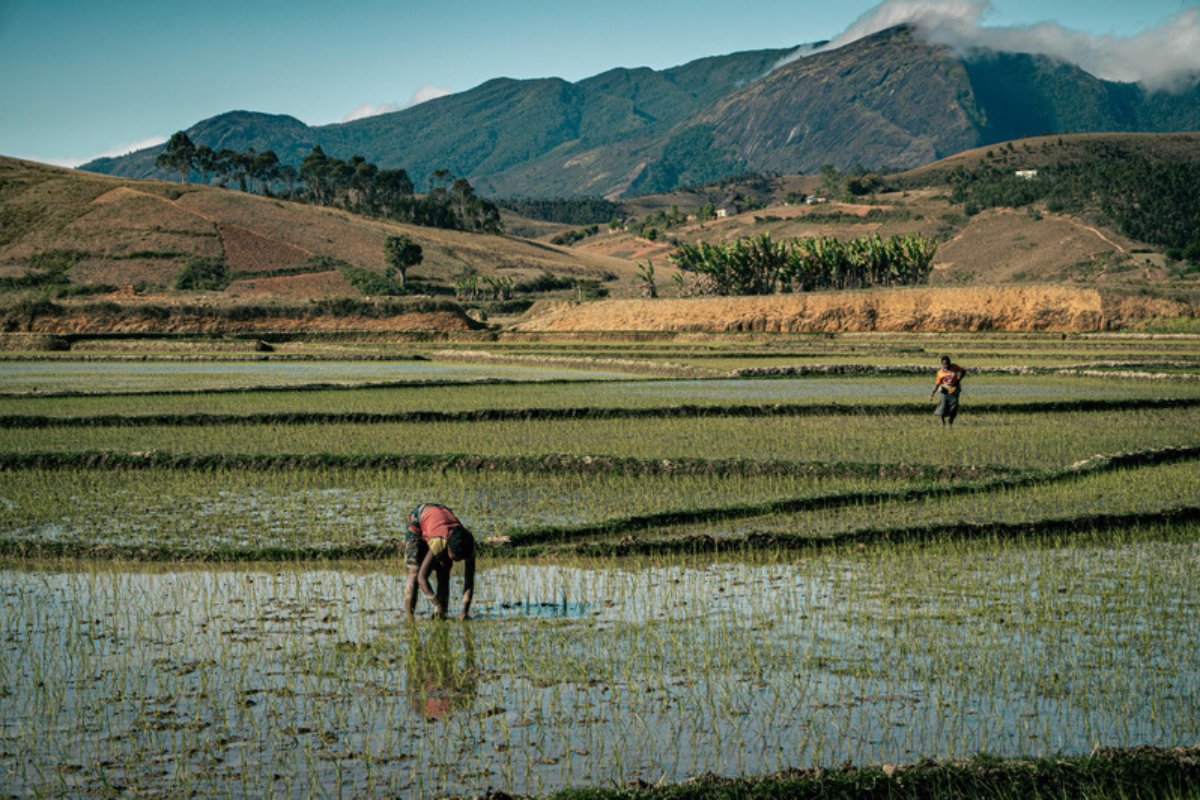
Farming in Madagascar faces two major problems, the degradation of natural resources and an economy that is stagnating while the population grows fast. Apart from a few small areas of young volcanic soil, the soils are poor and erode very easily. Several causes add up, including the loss of vegetation cover to bush fires, tavy (slash-and-burn farming) and deforestation, irregular and often heavy rain, steep terrain, and ferralitic soils that are naturally poor and acidic.
Working in these conditions takes a clear approach that suits farmers and meets the challenges of both the environment and production. In the highlands, we therefore explained agroecology to farmers so that they could understand it and then apply it themselves.
Why agroecology?
Agroecology answers two needs at once. Production has to increase and diversify in a lasting way, as a source of income and food security. At the same time, local natural resources, soil, water and forests, have to be protected, because they exist but are limited and under threat. The practices to promote depend on conditions in the field, however, and a technical pathway has to be designed for each situation.
A technical pathway built from one question
The technical pathway we use was designed in 1994 by K. Schuler and the author of this article, to convince farmers that agroecological practices work. The aim is to help them understand the importance of soil and water, and to put protecting the soil before any other work. Everything starts from one simple question, "What do I want to produce on my plot, and how?"
From the answers, three more questions follow.
- Which measures will stop the loss of soil?
- How can I maintain and improve the fertility of my plot?
- Which techniques will I use?
Once the farmer has answered these three questions and accepted the answers, the work follows a set order, first soil conservation, then fertility management, and finally improved production techniques. The farmer always has to carry out all three steps to produce sustainably with good yields.
Plots are small, often under 0.5 hectares, and lie on hillsides. Poverty is widespread in the countryside, where about 80% of rural people lived below the national poverty line in 2022, according to the World Bank. Solutions therefore have to cost little and show visible results.
Three steps taken in a fixed order
Farming in Madagascar's highlands is rainfed. It takes place on hills and slopes between 700 and 1,500 metres above sea level.
Protect the soil with living hedges
The first step is to plant grasses, mainly vetiver, along the bottom edge of each plot. Vetiver is chosen because zebu cattle do not eat it. The animals are often tethered in the open without fences, and they can break loose and wander through the fields. Where vetiver is not available, some farmers use brachiaria.
The hedges are planted in two rows 30 cm apart, with 15 to 20 cm between plants, staggered. They sharply slow the run-off of rainwater, stop the topsoil from washing away and help keep nutrients in the field.
Manage fertility with compost
The second step is to make and use compost. On the ferralitic soils of the highlands, compost reduces acidity, improves soil structure, helps roots go deeper and increases water retention. Good compost also supplies the nutrients plants need, and it supports soil microbes and soil biodiversity.
Farmers have very little money for fertiliser, so producing compost is the best answer. It can be enriched with wood ash, which adds potassium, and bone meal, which adds phosphorus, both of which are also present in animal manure. The usual rate is two handfuls of compost per planting hole, roughly 5 tonnes per hectare. Crops are planted in pockets or in rows to make the most of the compost, which is hard to produce in large amounts because plant material is scarce.
Improve production techniques
The first practices taught are planting in rows and mulching. Farmers first had to be persuaded to plant in rows, because they were used to sowing at random to fill their plots as much as possible. Then each plant had to be mulched, mostly with rice straw, since almost every farmer also grows rice. Together the two practices give roots more room, hold water better and keep weeds down. Intercropping and crop rotation will be introduced step by step later.
Higher yields for every crop
Planting in rows with compost, behind living hedges at the bottom of each plot, gave good results. After two years of practice, yields rose for every crop grown with the technical pathway, from 26% for tomato to 65% for cassava. Even the smallest gain, for tomato, is already a real success for families farming less than half a hectare.
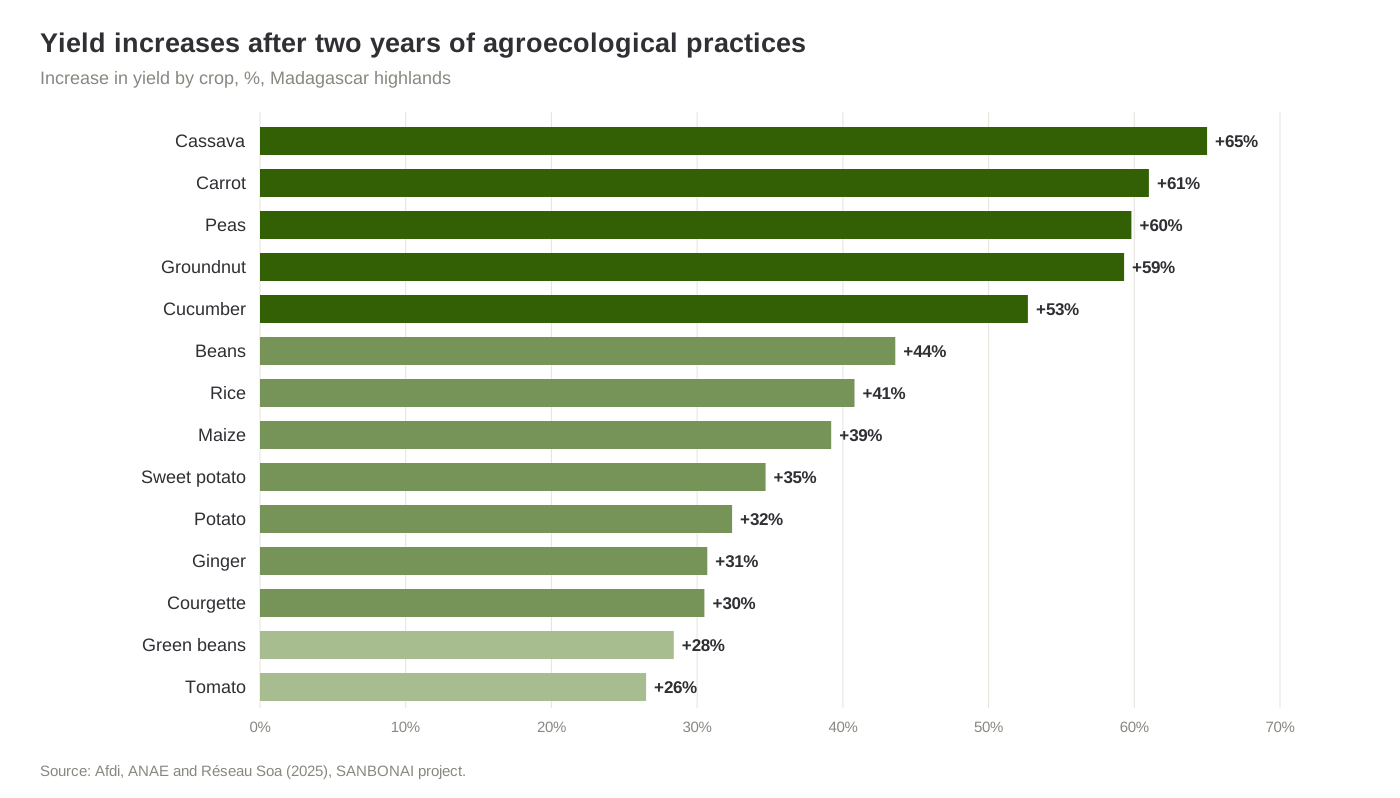
Yield increases after two years of practice. Source: Afdi, ANAE and Réseau Soa (2025), SANBONAI project.
Fit the practices to the farmers
Many techniques have been developed and tested over the years, such as contour lines, bunds, terraces, climate-smart agriculture and conservation agriculture. Yet they are often poorly suited to farmers' socio-economic conditions, their means and the time they have for work. Farmers will not take on heavy work for uncertain results. They should not be pushed too fast towards new practices, however effective, and the task is to find ways to make them want to start.
In this case, living hedges at the bottom of the plots, compost, row planting and mulching gave good results. These practices were chosen from experience built up over several farming projects. Many practices exist and are open to every producer, but proving that they work is one thing, and spreading them through the whole farming community is another. Watching closely what happens in the field and adapting techniques to local realities remains the best way to improve the lives of rural families.
Sources
World Bank (2024). Navigating two decades of high poverty and charting a course for change in Madagascar. Poverty and Equity Assessment. Washington, DC.