

What is social farming?
Social farming is an approach to agriculture that combines farming with social, educational, and sometimes therapeutic activities for people with specific support or inclusion needs. It uses real farm environments and everyday agricultural work to create opportunities for learning, rehabilitation, confidence-building, and participation in community life. Because it places human development and inclusion at the heart of agricultural activity, social farming has become an important tool for promoting social integration, strengthening rural communities, and supporting more sustainable, values-based food systems.
Why is social farming important?
Social farming expands the role of agriculture beyond food production and turns it into a practical tool for inclusion, learning, and reintegration. Across different settings, social farming creates structured opportunities for people who are often excluded from the labour market or social life, including vulnerable groups, people in recovery, and people leaving closed institutions.
At its core, social farming connects human development with meaningful work on the land. Research describes it as a flexible model that combines agricultural activity with social support, education, therapeutic value, and pathways to employment. This is especially important today, when many communities face overlapping challenges: social isolation, fragile local economies, pressure on food systems, and the need for more sustainable forms of production.
Its value is not only theoretical. Social farming can help people rebuild confidence, develop practical and soft skills, and regain a sense of purpose through daily participation in real production processes. In settings linked to reintegration, this matters deeply because training is more effective when it is connected to responsibility, routine, cooperation, and visible results.
The environmental and community dimensions also make social farming particularly valuable. It supports more sustainable agricultural practices while strengthening local ties and showing that farms can also function as spaces of care, education, and community resilience. Rather than separating social policy from food production, social farming brings them together in a way that is tangible, skills-based, and locally rooted.
The Social Farming 360° project
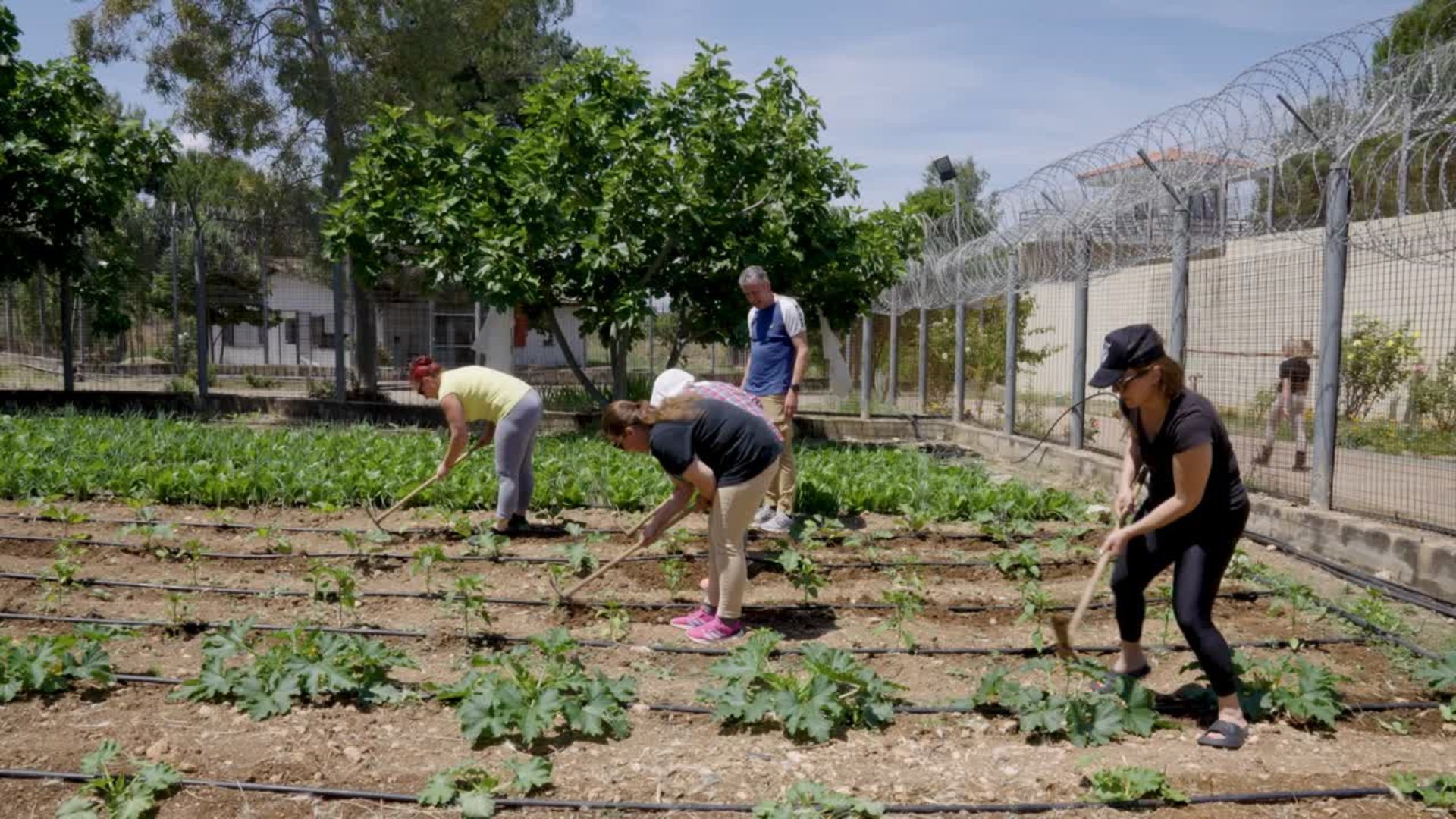
A strong example of this approach in practice is Social Farming 360°, an innovative two-year programme implemented in Greece by New Agriculture New Generation with the full support of the Citi Foundation, in close collaboration with the General Secretariat for Anti-Crime Policy of the Ministry of Citizen Protection and with the participation of ActionAid and Freedom Gate. The programme was implemented in six correctional facilities and connected sustainable agricultural production, food security, agricultural training, employability actions, and psychosocial support as part of a broader reintegration effort.
Its scale shows why the model deserves attention. According to the programme results, Social Farming 360° recorded more than 1,000 participations, delivered 648 hours of training, and led to 696 ACTA professional certifications, which points to the potential of social farming to operate as a scalable model for skills development within closed structures.
The inmates share their experience of the programme in a new short documentary
To bring this impact closer to the public, the team of New Agriculture New Generation created a short documentary around Social Farming 360° which focuses on the testimonials and voices of the beneficiaries themselves, showing how experience, reflection, and personal testimony can reveal the real meaning of social farming beyond measurable outputs.
Through these stories, the documentary presents social farming as a lived experience, one that can support dignity, agency, growth, and a renewed sense of direction.
This storytelling approach is important because numbers can confirm scale, but personal narratives explain value. When participants describe in their own words what the programme left them with, the audience can better understand how innovative actions like these create lasting impact at both individual and community level.
Watch the documentary with English subtitles and discover how social farming can open pathways to inclusion, skills, and hope through real stories of change. Watch the full documentary.