


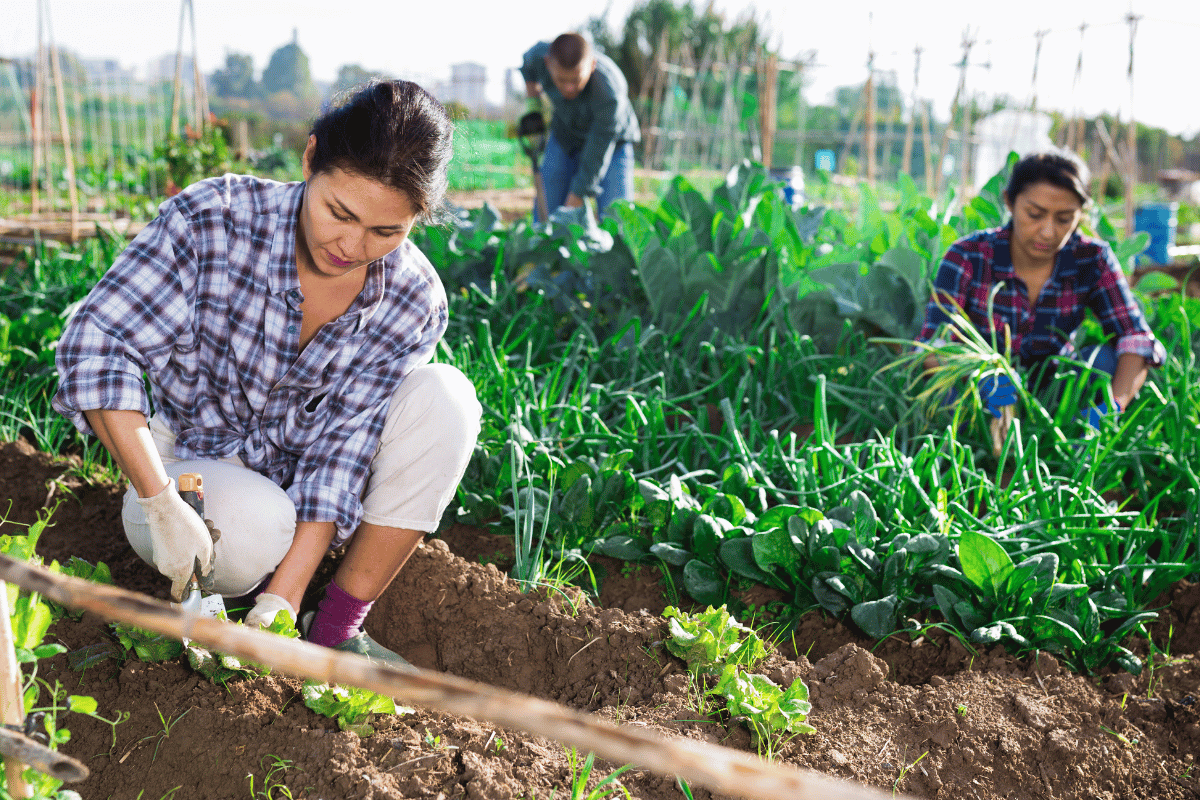
A farm can grow more than food. With the right partnerships, it can also offer people routine, purposeful work, contact with nature, and a place to belong.
Social farming uses everyday farm resources, meaning land, crops, animals, buildings, skills, and the farm community itself, to support people who need additional social, educational, or health-related support. In some countries it is called care farming. The people involved may be experiencing mental health challenges, neurodivergence, or physical impairments, recovering from addiction, or overcoming long-term unemployment, isolation, or a difficult life transition, as set out by the EU CAP Network Focus Group on social farming.
For farmers, social farming is a form of diversification. For participants, it can become a meaningful part of recovery, inclusion, and everyday well-being. It is important to be clear from the outset that it works alongside professional health and social-care services rather than replacing them.
My own route into social farming came through visiting farms that use agricultural work to create space for participation. At the Vintlerhof in South Tyrol and the AQUA Mühle Garten in Austria, I saw that social farming is not simply a matter of bringing people into a green environment. It is about organising real work so that people with different abilities, experiences, and support needs can contribute. Growing vegetables, caring for plants, preparing produce, and working alongside others all become opportunities to build routine, skills, confidence, and relationships.
A visit to Orti Etici, the social agriculture project at the University of Pisa, added another dimension. There, social farming connects cultivation, research, and social inclusion in a university setting. It showed me that farms and gardens can be places where social innovation is tested in everyday practice, through shared responsibility for living things, food, and a common space, rather than through abstract programmes.
That perspective now informs my work on the AlterPerimentale project in eastern Germany, which focuses on quality of life for older people in rural areas, in a region affected by demographic change and thin social infrastructure. Social farming is relevant there because it can offer more than care. It can create meaningful roles, regular contact, and a way to remain part of community life.
What does social farming look like?
There is no single model. A social farm may be a family farm, a social cooperative, a farm linked to a care provider, or a community project. The activities should fit the farm, the season, the participants' abilities, and the support available. In practice they include:
- Sowing, planting, weeding, watering, and harvesting vegetables
- Feeding animals, cleaning pens, collecting eggs, and preparing bedding
- Sorting, packing, processing, and selling farm products
- Maintaining paths, hedges, orchards, gardens, and wildlife habitats
- Cooking with farm produce or preparing a shared meal
- Taking part in farm-gate sales, markets, school visits, and community events
These are ordinary farm tasks, organised with clear routines, realistic expectations, and appropriate supervision. The purpose is not to keep people busy. It is to enable participation in useful work and in community life.
Why can farm work support wellbeing?
A social farm brings together three things that are often missing when someone is experiencing mental distress, which are a reason to get up, supportive contact with other people, and time in a natural environment.
Purposeful activity matters. Planting a row of vegetables, feeding animals, or preparing produce for sale gives a participant a task with a visible result. Over time, regular tasks can help build confidence, practical skills, and the sense that a contribution matters.
Relationships matter. Social farming is usually group-based, with participants working alongside farmers, support workers, volunteers, and peers. That can reduce isolation and create low-pressure opportunities for conversation, shared learning, and mutual support. A systematic review of farm-based interventions for people with diagnosed mental health conditions identifies the social and work-related aspects of farm participation as important potential benefits.
Nature matters. Farms provide changing seasons, weather, plants, soil, animals, and outdoor movement. A major review of nature and mental health concludes that contact with nature can support cognitive functioning and emotional wellbeing. On a social farm this contact is not separate from the daily activity, it is built into the work, the breaks, and the relationships.
These elements reinforce one another. A participant may not come to a farm to receive therapy. They may come to feed hens, help prepare a vegetable box, or learn to prune fruit trees. Through doing something useful with other people in a green setting, they may nonetheless experience more confidence, connection, and calm. Research on social farming as an approach to mental health, social inclusion, and community engagement points in the same direction.
In my work with rural practitioners, the most common misconception is that the natural setting does most of the work, that simply being outdoors, near animals or plants, is what helps. In practice, the farms and initiatives I have seen succeed treat the green environment as the backdrop rather than the mechanism. What consistently makes the difference is whether someone has a task they can complete and see the result of, and whether they are met by the same person, or the same small group, week after week. A farm without reliable relationships and clear, achievable tasks is just a field. A farm that offers both can become one of the most effective and least expensive forms of social support available in a rural community.
The evidence is promising, and it should be communicated carefully. The same systematic review that found encouraging results for participants with diagnosed conditions also called for stronger research on social and occupational outcomes. Social farming is best understood as a supportive, practical complement to clinical treatment, counselling, and social care where those are needed.
Benefits beyond the participant
Social farming can also strengthen the farm and the community around it. The EU CAP Network Focus Group found that social farms can combine economic, social, and environmental goals, creating new farm income, encouraging diversification, building links with consumers and local organisations, and making farms more visible as places of learning and community life. The benefits can include:
- An additional and more stable income stream, particularly where services are commissioned by municipalities, health providers, schools, or social-care organisations
- New partnerships with local charities, schools, health professionals, employment services, and rural-development organisations
- More opportunities for direct sales, farm events, workshops, and educational activities
- A stronger connection between urban residents, consumers, and agriculture
- A more active local role for small and medium-sized farms
Income should not be the only reason to begin, though. In the same Focus Group, many experts considered personal meaning, social connection, and the opportunity to support others to be more important motivations for farmers than additional income on its own.
Start with partnerships, not promises
A successful social farm is not created by placing vulnerable people on a farm and hoping nature will do the rest. It takes planning, boundaries, and professional collaboration. Before starting, it is worth working through several questions.
Who will the farm support? Begin with one clearly defined group, such as adults experiencing social isolation, young people needing work experience, or people referred through a local support service.
Which activities are genuinely safe and suitable? Choose predictable tasks with manageable risks, and avoid assuming that every farm activity suits every participant.
Who provides professional support? Farmers bring agricultural knowledge. Social workers, occupational therapists, educators, and mental-health professionals bring other essential skills. Agree in advance who is responsible for participant support, safeguarding, risk assessment, communication, and emergencies.
How will the activity be funded? Funding may come through contracts with health, social-care, education, employment, or local-development services. Some farms combine this with direct sales, community events, or other diversification.
What training and support do farm staff need? Training, mentoring, and peer exchange all matter, particularly when working with a new participant group. Social-farming networks, agricultural advisers, and Local Action Groups can help farmers work through unfamiliar requirements and make contact with service providers.
Start small. A farm might host a supported group of three or four people for one morning a week, working with a local social-care organisation. That lets the farmer and the partner organisation test routines, assess risks, and adapt the activities before expanding.
A different role for the farm
Social farming does not require a farm to become a clinic. The farm remains a real working environment, with real tasks and real limits, and that is part of its value.
Di Iacovo describes social farming as a retro-innovative approach, reconnecting traditional rural resources, nature, practical work, food production, and community, with current needs for more inclusive forms of care and rural development. Countries organise and fund it differently, so there is no universal blueprint. The right model depends on the farm, the local regulations, the available partners, and the needs of the participants.
For farmers interested in this path, the key message is straightforward. Social farming is not about doing everything alone. It is about combining farming knowledge with trusted partnerships, so the farm can stay productive while becoming a place of meaningful participation.
A good starting point is the EU CAP Network Focus Group on social farming and innovations, which brought together 20 experts from across Europe to examine how farms can combine agricultural production with social inclusion, health, education, and employment support. Its resource page includes a final report, a booklet of farm-based projects, and short practical papers on the issues that matter when starting out, covering quality assurance, measuring social and farm-level impacts, advisory and brokerage support, links with Local Action Groups through LEADER, and ways to connect agriculture with social-care, education, and employment services. The materials deliberately avoid a one-size-fits-all model, since national rules, funding, welfare systems, and farm types all differ, but they are a useful first step for understanding which questions to ask and which local partners to involve.
After reviewing the European examples, the practical next step is to contact a regional agricultural advisory service, a Local Action Group, or a relevant social-care provider. A visit to an established social farm in your own country is usually the most useful move of all.
Sources
Borgi, M., Collacchi, B., Correale, C., Marcolin, M., Tomasin, P., Grizzo, A., Orlich, R., and Cirulli, F. (2020). Social farming as an innovative approach to promote mental health, social inclusion and community engagement. Annali dell'Istituto Superiore di Sanità, 56(2), 206-214.
Bratman, G. N., Anderson, C. B., Berman, M. G., et al. (2019). Nature and mental health, an ecosystem service perspective. Science Advances, 5(7), eaax0903.
Di Iacovo, F. (2020). Social farming, evolutionary web from public intervention to value co-production. Sustainability, 12(13), 5269.
EU CAP Network Focus Group on social farming and innovations (2023). Focus Group report. European Commission.
Iancu, S. C., Hoogendoorn, A. W., Zweekhorst, M. B. M., Veltman, D. J., Bunders, J. F. G., and van Balkom, A. J. L. M. (2015). Farm-based interventions for people with mental disorders, a systematic review of literature. Disability and Rehabilitation, 37(5), 379-388.