


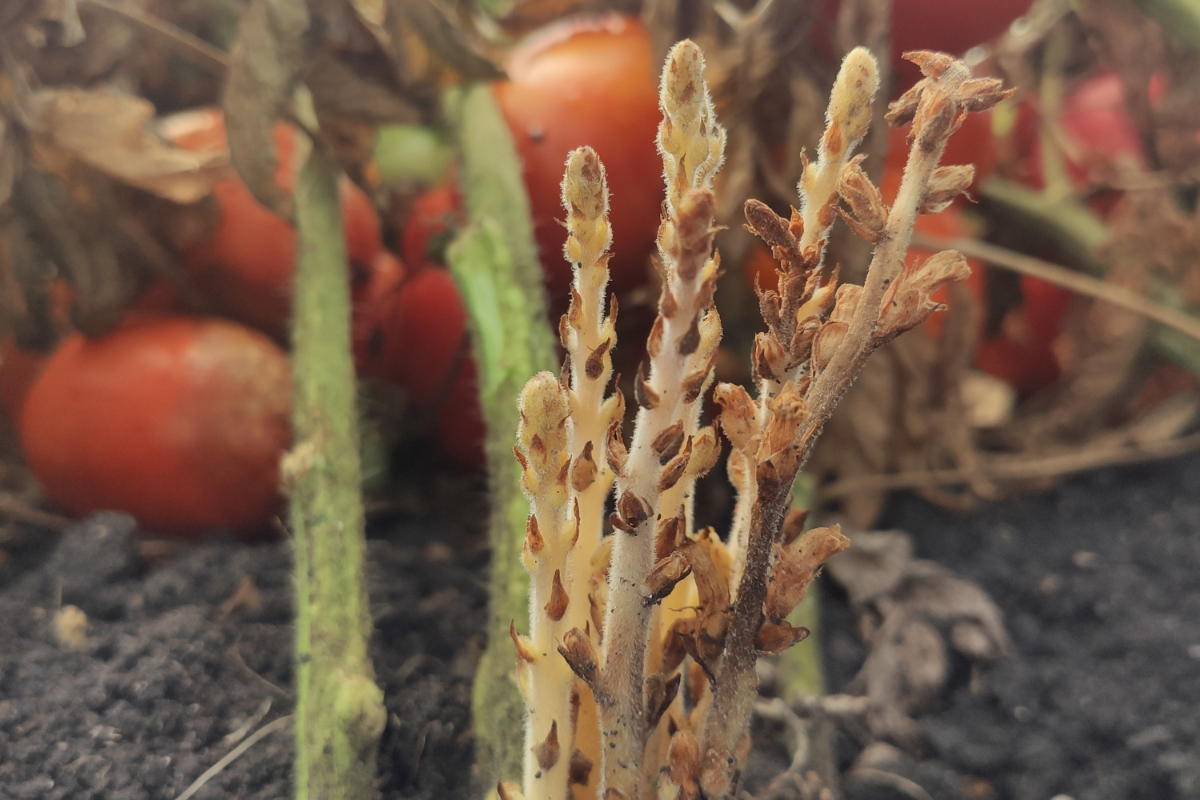
Around the world, farmers face numerous challenges, including drought, soil degradation, pests, and diseases. Among these, broomrapes, root parasitic weeds, are serious but the least known threats. These plants can cause yield losses of 30% to 80% worldwide in key food and industrial crops [1]. The impact is most dramatic in regions with a hot and dry climate where crops endure growth with limited resources. Economic losses from parasitic weeds in Africa are estimated at US$200 million [2].
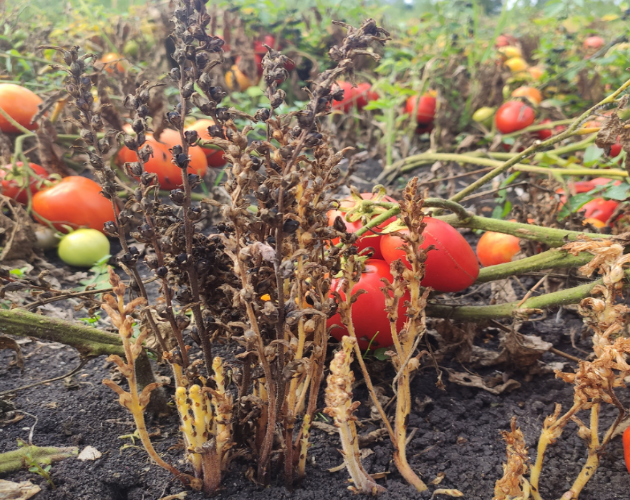
Figure 1. Broomrape plants in a tomato field, Slovakia (Photo – M. Kryvokhyzha).
What are parasitic weeds?
Parasitic plants cannot live independently. They have lost the ability to photosynthesize and rely on host plants to acquire water, minerals, and nutrients. They can harm or even kill host plants [3].
Broomrapes are a dangerous group of weeds from the genera Orobanche and Phelipanche (Fig. 1). There are over 100 known broomrape species, and several of them pose a significant threat to sunflowers, tomatoes, tobacco, legumes, and other essential crops [4]. Their impact is growing, especially in the Mediterranean region, the Middle East, and parts of Africa and Asia.
Broomrapes have a unique smart life cycle
Broomrapes have a unique life cycle, which makes them difficult to control. A single plant produces tens of thousands of tiny seeds, literally the size of dust. These seeds can remain alive in the soil up to 20 years, waiting for a suitable host plant [5].
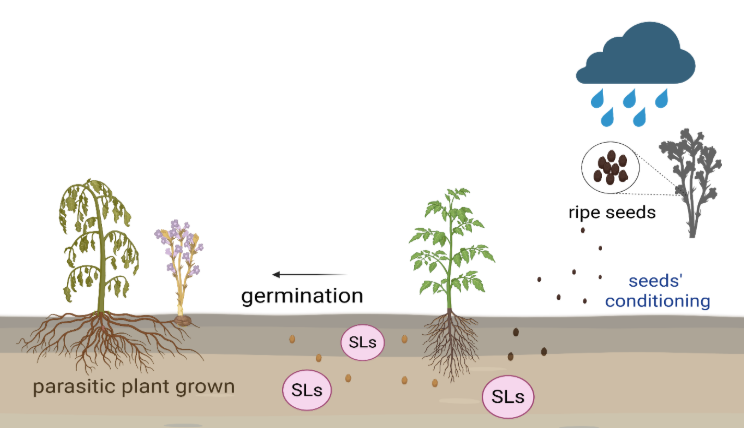
Figure 2. Root parasitic plant life cycle; SLs—strigolactones (Figure created by M. Kryvokhyzha using Biorender).
The seeds respond to a signal indicating that a potential tasty host is nearby. They recognize the victim sensing special plant hormones, strigolactones, that crop roots release into the soil [6]. Strigolactones help plants to regulate their growth, but unfortunately, they also serve as a wake-up signal for parasitic weeds (Fig. 2). Host strigolactones stimulate parasitic seeds to germinate and grow toward the victim’s root, where the seedlings attach and begin to feed [7].
Why are broomrapes so hard to control?
Broomrapes live underground for most of their lives, so they are challenging to detect or remove. Farmers realize that fields are infected only after the parasites have already damaged the crops and reached the flowering stage. Conventional weed control methods, as herbicides or mechanical removal, are ineffective. Moreover, the seeds’ longevity in the soil and easy collateral contamination during farming-related activities (Fig. 3) make eradication extremely challenging [3].
Climate change exacerbates the problem, causing stress in agriculturally important plants. Parasitic weeds further weaken crops, stealing vital resources from their hosts.
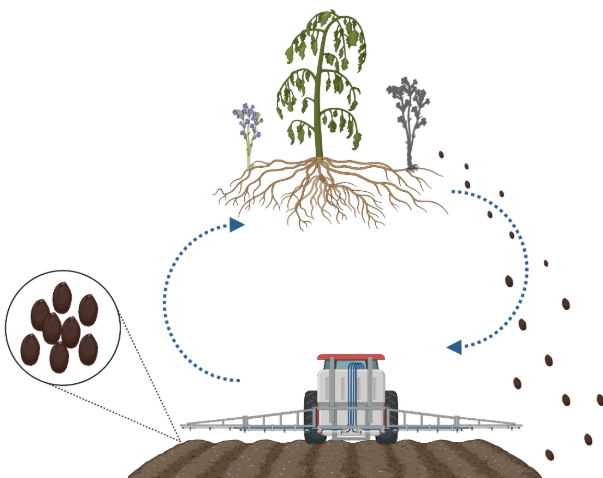
Figure 3. Parasitic weeds could infect new fields through farming-related routes (Figure created by M. Kryvokhyzha using Biorender).
Scientists are seeking a solution by developing resistant cultivars
Research focuses on preventing the broomrape from attaching to the host roots or stopping the parasite from developing after it has attached.
For example, some sunflower cultivars can reduce germination of broomrape seeds, while others can block the connection between the parasites and their vascular system. Scientists use powerful genetic and molecular methods to understand these processes and produce new resistant cultivars [8].
Another approach is to develop specific herbicides based on knowledge of the molecular mechanisms involved in the germination of broomrape [9]. A deep study of parasitism has the potential to create elegant and effective solutions that target parasites only and save crops.
Parasitic weeds endanger food security and sustainability
Research on broomrapes and other parasitic weeds continues to expand, bringing together experts from various fields, including plant physiology, genetics, chemistry, ecology, and agronomy. The germination of broomrape seeds attracts a lot of attention. Although it is known that strigolactones promote the germination of broomrape seeds, fine molecular details remain a mystery [10].
A combination of biochemical and biotechnological methods can identify the proteins involved in launching germination. Understanding such protein networks facilitates the design of protection strategies.
Exciting scientific discoveries will open new paths for managing broomrapes and related parasites, ensuring more sustainable and secure agriculture.
Author, Maryna Kryvokhyzha, is supported by EU NextGenerationEU through the Recovery and Resilience Plan for Slovakia grant 09I03-03-V01-00142.
References
[1] D. M. Joel, J. Gressel, and L. J. Musselman, Eds., Parasitic Orobanchaceae: parasitic mechanisms and control strategies. Berlin, Heidelberg: Springer Berlin Heidelberg, 2013.
[2] J. Benjamin et al., “Cereal production in Africa: the threat of certain pests and weeds in a changing climate—a review,” Agric. Food Secur., vol. 13, no. 1, p. 18, Apr. 2024.
[3] R. Aly and N. K. Dubey, “Weed Management for Parasitic Weeds,” in Recent Advances in Weed Management, B. S. Chauhan and G. Mahajan, Eds., New York, NY: Springer New York, 2014, pp. 315–345.
[4] P. Duriez et al., “A receptor-like kinase enhances sunflower resistance to Orobanche cumana,” Nat. Plants, vol. 5, no. 12, pp. 1211–1215, Dec. 2019.
[5] M. Fernández-Aparicio, X. Reboud, and S. Gibot-Leclerc, “Broomrape weeds. Underground mechanisms of parasitism and associated strategies for their control: A review,” Front. Plant Sci., vol. 7, Feb. 2016.
[6] C. De Cuyper, S. Struk, L. Braem, K. Gevaert, G. De Jaeger, and S. Goormachtig, “Strigolactones, karrikins and beyond,” Plant Cell Environ., vol. 40, no. 9, pp. 1691–1703, Sept. 2017.
[7] R. Matusova, T. V. Mourik, and H. J. Bouwmeester, “Changes in the sensitivity of parasitic weed seeds to germination stimulants,” Seed Sci. Res., vol. 14, no. 4, pp. 335–344, Dec. 2004.
[8] Z. Yao et al., “Global transcriptomic analysis reveals the mechanism of Phelipanche aegyptiaca seed germination,” Int. J. Mol. Sci., vol. 17, no. 7, p. 1139, July 2016.
[9] G. Brun, L. Braem, S. Thoiron, K. Gevaert, S. Goormachtig, and P. Delavault, “Seed germination in parasitic plants: what insights can we expect from strigolactone research?,” J. Exp. Bot., vol. 69, no. 9, pp. 2265–2280, Apr. 2018.
[10] F. Yu, M. Li, D. He, and P. Yang, “Advances on Post-translational Modifications Involved in Seed Germination,” Front. Plant Sci., vol. 12, p. 642979, Mar. 2021.