


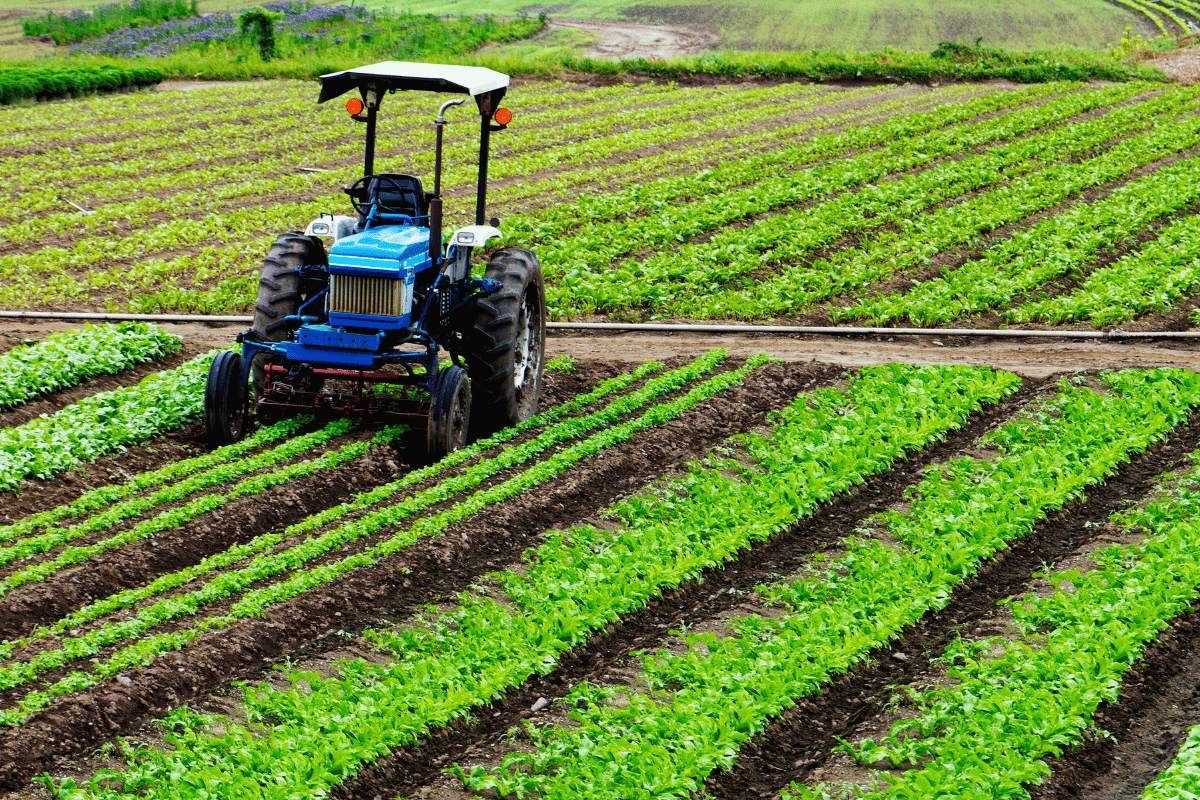
Precision agriculture is usually defined as site-specific resource management. The definition is accurate, but it can be read in more than one way. Most often, "site-specific" is understood at the field level, applying water, fertiliser, or pesticides accurately within a farm, sometimes to centimetre precision. The word "site", though, should also carry the wider context of where the farm sits.
An agricultural site is more than a point on a map. It is shaped by geographical location, plot size, climate, soil type, access to markets and machinery, the capital and labour a farmer can call on, and the farmer's own ability to use technology and benefit from it. A precision agriculture system that works well for a large commercial farm in the United States will behave very differently in the hands of a smallholder in India or across Africa. True site-specific management, therefore, has to account for the regional, social, and economic realities around the field, as well as the variation within it. That leads to the question that decides everything else: who can actually afford to adopt precision agriculture?
Who the current model is built for
For large farms in developed countries, new agricultural technology is relatively easy to take on, because those farmers have capital, advanced machinery, good market access, and the infrastructure for commercial production. The global picture looks different. Across much of Asia and Africa, agriculture is still dominated by small and marginal farmers, working land that is often small, fragmented, and financially exposed. For them, modern approaches can sound useful in theory while being hard to put into practice.
This does not make precision agriculture irrelevant to small farmers. It means the approach has to be designed differently, built around local risks, needs, and limits. The starting point has to be the farmer's own priority, because only then does anything new take root naturally.
What a smallholder actually needs
For a small farmer, the biggest goal is usually to save money. The challenge is not simply to grow more, but to earn more from what is already grown. In today's food system, transport, storage, processing, packaging, marketing, and retail absorb a large share of the final price consumers pay, while the primary producer receives only a small share of that value. If precision agriculture concerns itself only with increasing yield while minimising inputs and leaving the farmer's economic position untouched, it may deliver little.
Small farmers face a set of connected barriers:
- limited capital to invest in sensors, drones, or advanced machinery
- small and scattered landholdings
- little access to technical training
- dependence on middlemen
- weak access to storage and processing facilities
Because of these barriers, precision agriculture in these regions cannot look like its counterpart in developed countries. A smallholder cannot afford to own a drone, a weather station, or a full digital monitoring system. What the farmer does need is useful information, at the right time and at a price within reach. That is where a broader idea of precision agriculture becomes necessary, one that is not tied to privately owned expensive machines, drones, sensors, or software.
The case for a shared model
At heart, precision agriculture should lead to better decisions, grounded in data that reflects local conditions. For small farmers, that is likely to work only through shared or community-based models, not individual ownership of costly technology, and it can be done with the support of local government institutions. A group of farmers, a cooperative, a village-level service provider, or a local agribusiness centre can deliver precision agriculture services to multiple farms simultaneously.
India's Amul offers a useful parallel. Amul brought millions of small dairy producers into one organised system, with milk collection, processing, marketing, and distribution handled collectively through a three-tier cooperative structure. An individual dairy farmer might own only a few animals and little infrastructure, but within the cooperative, those farmers gained access to processing facilities, reached national and international markets, and became genuine shareholders in the value chain rather than price-takers at its edge.
The same principle can be adapted to precision agriculture. A single farmer with one or two hectares cannot justify a drone survey or a digital advisory system alone, but a cooperative, a farmer organisation, or a local service centre could provide those services to many farmers together. That shift matters because it is what stops precision agriculture from becoming yet another technology that widens the gap between large and small farms. Designed as a shared service, it becomes a practical tool for smallholders instead. The goal was never to own the technology. It is to have a decision-support system that tells a farmer where to apply water, when to fertilise, and which part of a field is under stress, thereby cutting resource use and unnecessary input costs.
Sources
Amul (Gujarat Cooperative Milk Marketing Federation). A note on the achievements of the dairy cooperatives.