


Avocado production has expanded rapidly in many parts of the world, driven by market demand and by the crop's potential to provide long-term income. Achieving consistent productivity and fruit quality, though, takes more than planting trees and applying fertiliser. It depends on understanding the soil, managing water carefully, monitoring tree health, and making decisions based on reliable information rather than habit.
At Mustard Agro Ventures in Tanzania, we farm 10 acres of avocados, planted in two blocks of 5 acres, each carrying around 2,000 trees, with a third block of the same size going in next. What the work has taught us is that modern farming is not simply a matter of adopting new technology. It is a matter of combining technology with sound agronomy. By integrating precision agriculture tools, soil improvement, and continuous field monitoring, we have been developing a more sustainable approach to the crop.
Understanding the problem before buying the solution
One of the biggest difficulties in managing avocado orchards is that every field is different. Soil fertility, water availability, climate and tree performance can vary considerably even within a single farm.
Like many growers, we began by relying mainly on visual observation and general recommendations. It became clear that some decisions needed better information than that. Questions such as how much water each tree actually needs, whether nutrients are being taken up effectively, whether fertiliser is matched to the crop's real requirements, and how to improve soil health for the long term, cannot be answered by looking at a tree.
That is what pushed us towards precision agriculture and better monitoring.
Irrigation, and what the sensors changed
Water management is among the most critical factors in avocado production, since both under-irrigation and over-irrigation damage tree growth, root health and yield.
We learned that the hard way. Before we installed soil moisture sensors, irrigation was scheduled based on experience and estimation. Water was not scarce for us, but having enough water is not the same as knowing how much the trees need. We over-irrigated, the root zone stayed wetter than it should have, and we lost more than fifty avocado trees to Phytophthora root rot. On an orchard of 2,000 trees that is well over 2% of the planting, there is a problem we were causing ourselves. The cost of guessing was not worth it. It was drowning.
We then installed AquaCheck soil moisture probes across the planted blocks. These are capacitance probes with sensors spaced along their length, so they report moisture at several depths rather than at one, which lets us see how water actually moves through the profile rather than only whether the surface is wet.
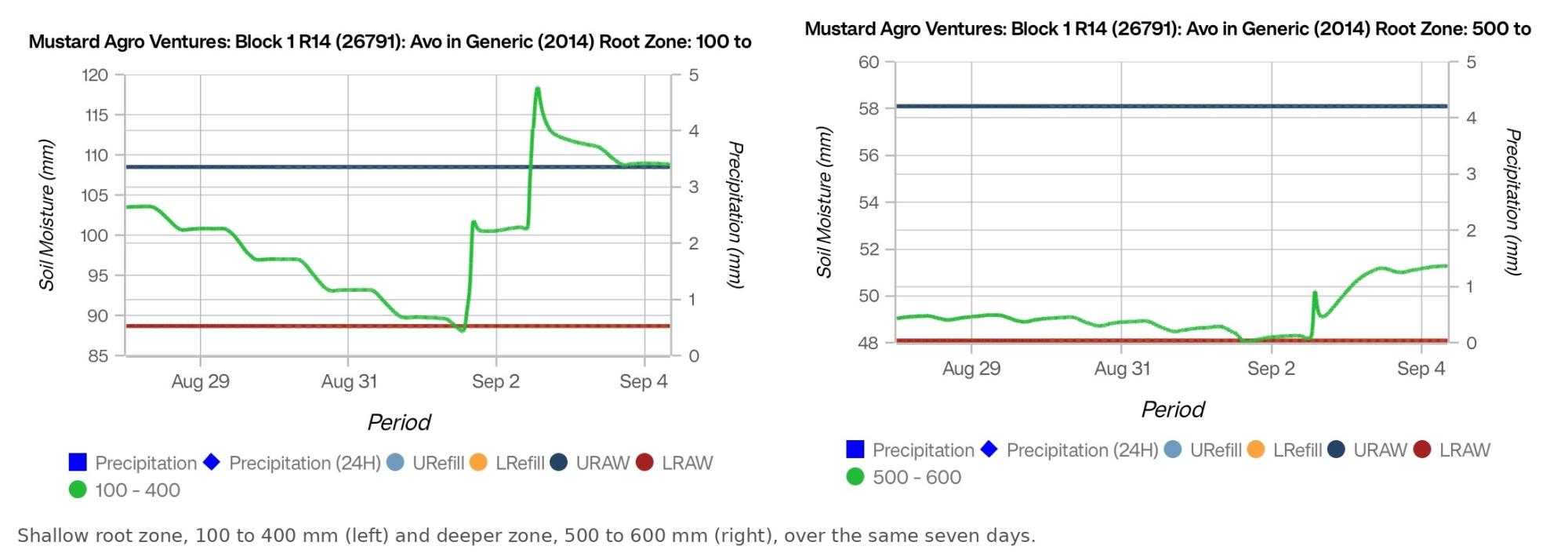
Seven days of readings from one block. The shallow zone falls to the refill line, is irrigated, and draws down again. The deeper zone behaves differently, which is the argument for measuring at multiple depths.
What that looks like in practice is straightforward. In Block 1 R14, moisture in the 100 to 400 mm root zone fell gradually from around 103 mm to about 88 mm, at which point irrigation was applied. It rose to roughly 118 mm and then declined again as the trees drew on it. The deeper layer, at 500 to 600 mm, followed an entirely different pattern over the same week, which is precisely why measuring at a single depth is not enough. The question is never simply whether water is available. It is whether water is reaching the active root zone, and whether the amount matches what the tree can use.
We combine the sensor data with field observation, manual soil checks and dripper discharge testing, since a probe tells you what happened in the soil but not whether an emitter is blocked.
Since we began irrigating on sensor data rather than on a fixed schedule, we have had no new cases of root rot caused by irrigation mismanagement. The shift was in the question we were asking. We stopped asking how many hours to irrigate and started asking what the tree and the soil actually needed.
Building the soil rather than only feeding the crop
Healthy soil is the foundation of sustainable avocado production. Our soil analyses showed areas needing improvement, including low levels of several nutrients and poor structure and biological activity.
Rather than reaching only for mineral fertiliser, we began working on the soil ecosystem itself. One practice we introduced was producing biochar from the maize stalk residues our own farm generates, which turns a waste stream into a soil amendment at no material cost. Biochar contributes to soil structure, improves water retention, and provides a stable carbon source that supports soil microorganisms.
We combine that biochar with composted manure to make a nutrient-rich amendment for planting holes. For the third block, the five acres going in next, the mix is three buckets of composted manure to one bucket of farm-produced biochar, worked into the soil of each planting hole before transplanting. The aim is not only to supply nutrients but to create conditions in which roots will establish well, since a productive orchard depends on healthy roots and healthy roots depend on the soil around them.
We will run a soil analysis about six months after establishment to see what has actually changed in organic matter and nutrient status, rather than assuming the amendment did what we expected.
Letting the analysis decide the fertiliser
One of the clearest lessons has been that fertiliser application should follow the crop's needs rather than a routine.
We regularly use soil and leaf analyses to assess nutrient availability and plant nutrient status. These identify deficiencies, imbalances, and excess applications, which matter because all three cost money and only one is obvious from looking at the trees.
Leaf analysis has shown us cases where some nutrients sat above the requirement while others were limiting performance. That is not something visible in the orchard, and it changed how we plan nutrition. Rather than applying more fertiliser whenever trees show symptoms, we now identify what is actually causing the symptoms and correct it.
Pulling the information together
Precision agriculture is not really about sensors and equipment. The value lies in how you use what they tell you.
We bring together soil moisture data, weather information, soil and leaf analysis results, irrigation system performance checks, and field scouting observations. Each of these covers something the others miss, and read together they give a fuller picture of the orchard than any one of them does alone.
Technology does not replace a farmer's experience. It supports the judgment by supplying information the eye cannot gather.
What we have learned
Technology should address a specific problem on your farm; installing equipment without knowing which question it answers adds cost and little else. The value comes from interpreting the information and acting on it.
Precision agriculture demands continuous learning: farmers and managers must understand what the data mean and how they relate to what the crop is doing.
Sustainable practices and technology reinforce each other: improving soil health through organic amendments while precisely irrigating builds a system that supports both productivity and environmental responsibility.
Where is heading
We are working towards a farm where every significant decision rests on reliable information. For avocado growers, particularly those establishing new orchards, the advice is straightforward. Start by understanding your soil. Monitor your water. Watch your trees closely. Use measurement to confirm what you think you are seeing. And improve the soil, because productive trees begin with healthy roots.
Precision agriculture does not replace traditional farming knowledge. It strengthens it. The transformation on our farm has been a continuous process of learning rather than a single change, and for growers facing similar problems, the message is simply that better information leads to better decisions.