

Permanent Cover Crops in Semi-Arid Orchards: Benefits, Challenges, and Monitoring Tips
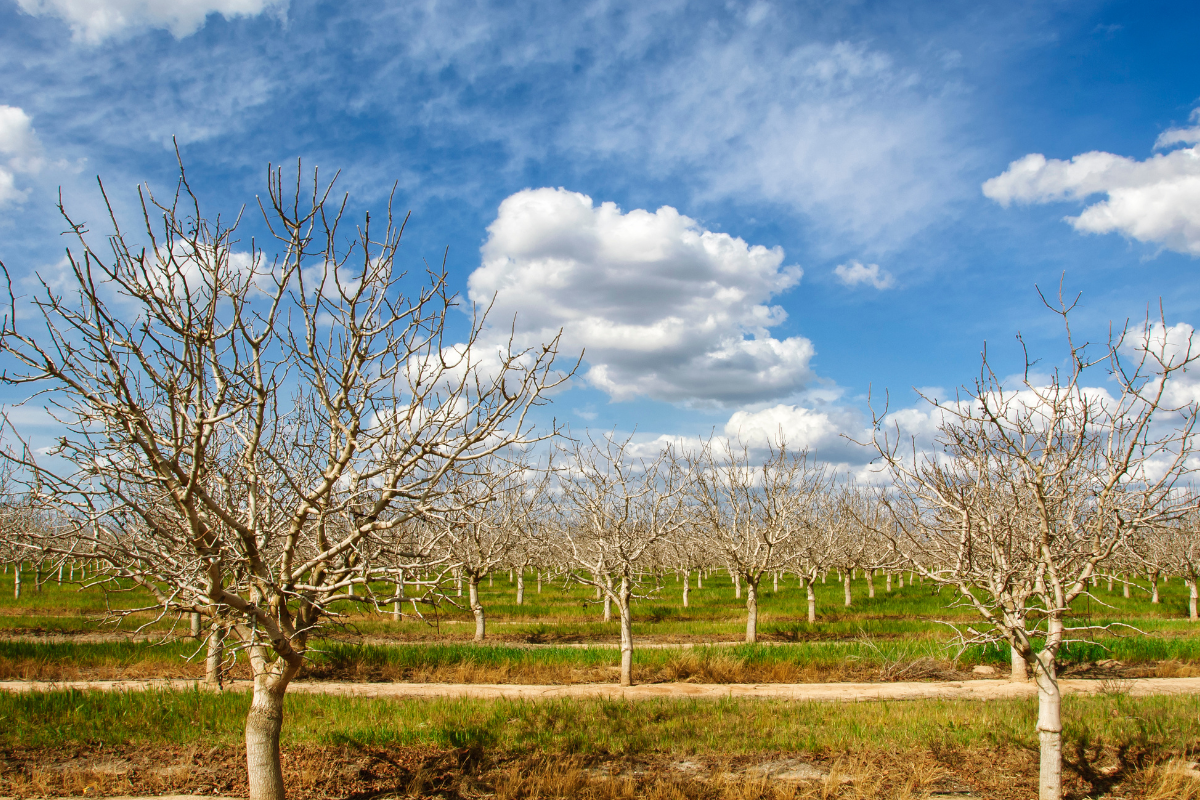
The Mediterranean region stretching from Portugal in the west to Isreal in the east is Europe's major olive, pistachio, and almond production area. These tree crops thrive in the semi-arid climate, where water availability is low and hours of sunlight are high. Under conventional management, the soil between the rows of trees is tilled multiple times a year to allow water to infiltrate more easily, leaving no room for vegetation to cover the bare soil. Under organic or regenerative management, tillage is lower or absent, creating the opportunity for cover crops to grow. This article explores the benefits and challenges of permanent cover crops in olive, almond, and pistachio orchards and provides actionable tips for monitoring their development over time.
Benefits of cover crops in olive, pistachio, and almond farming
There are multiple long-term benefits to reducing tillage and incorporating cover crops between trees.
The key advantages of cover crops in semi-arid climates include:
- Enhanced Soil Health: Cover crops improve soil health by increasing organic matter and nutrient content, fostering a fertile environment for tree growth.
- Control of erosion: Vegetative cover stabilizes soil structure. Plant roots anchor the soil, reducing erosion caused by wind and water.
- Increased resilience to extreme weather events such as long periods of drought or heavy rain events. The soil under cover crops has a higher porosity that allows water to infiltrate more easily. Vegetation cover creates protection against direct sunlight, making moisture at the soil surface less vulnerable to evaporation. Moreover, cover crops help increase the soil organic matter (due to crop residues and roots). Soil organic matter can improve soil water retention over a longer time.
- Biodiversity: the ecosystem of the whole production field will allow beneficial insects to thrive, creating a natural balance to control pests and diseases. Also, the underground biodiversity will increase as the reduction of tillage (which is very disturbing to soil life) and the interactions of soil organisms with plant roots contribute positively to different important processes in the soil.
- Weed suppression: Cover crops can antagonize weeds, leaving them less room to grow, facilitating weed control, and limiting problems caused by weeds like tumbleweed.
Achieving a Resilient Cover Crop Ecosystem
When implemented effectively, cover crops complement natural vegetation to create a robust and permanent cover crop mixture. Practices include:
- Reduced or no-till farming.
- Mulching pruned branches.
- Sowing diverse, region-adapted cover crop species.
- Managed grazing.
Challenges of cover crops in semi-arid climates
Implementing a new practice on your farm takes time and effort, and you need the financial capabilities to make the change. Especially in semi-arid climates where periods of drought are long, there is a risk that your cover crops may not succeed. Some of the main challenges include water scarcity, extremes in temperature, and poor soil fertility. Nevertheless, some challenges can be minimized, for example, by choosing cover crop species resilient to climate extremes and poor soil fertility. Implementing cover crops in your production system will support the resilience of your farming system over the long term.
How to Monitor Permanent Cover Crops
The vegetation in the cover crop on the field can be a combination of sown cover crops and the vegetation naturally occurring in the field or surroundings. Over the years, the composition of the species on the field can change. The key is to monitor the changes over time by studying certain indications of ecosystem functioning. The most feasible way of measuring is using a quadrant (50x50cm) to study the vegetation in the field. It functions as a tool to limit the study area and multiply the measurement on several fixed locations in the field. Using the same location points every time you measure creates a consistent overview of the development of your field. After placing the vegetation quadrant on the location, several measurements can be taken, focusing on vegetation and soil.
Species richness
The number of different species occurring in the field (species richness) and the area of ground cover. A higher diversity of species (higher species richness) positively contributes to ecosystem health, enhancing the natural balance of the system. Within the measurement quadrant, measure how many and which species occur.
Surface cover
Additionally, fully covered ground, with high percentages of surface cover, improves soil moisture by reducing water evaporation from the soil. Using the measurement quadrant, we estimate the percentage of covered surfaces by vegetation.
Ecological succession and functional groups
Ecological succession is the process of ecosystem change and development over time. The further the ecosystem develops, the more balanced and resilient the system is, and the more of the benefits mentioned above it can provide to the farm. Check what type of species occur within the measurement quadrant and classify them in ecological stages, which resemble different functional groups, such as annual or perennial plants.
- Begin situation: Disturbed soil. We start with bare soil, recently tilled.
- Hardy pioneers like Bromus spp. (grasses) and tumbleweeds occur. These annual species have the ability to survive under very harsh conditions and disturbance.
Over time and with limited disturbance, the weeds make it suitable for other plants to thrive, thereby transitioning the field to the next successional stage:
- After the annuals are established, the next succession can include leguminous species and more diversity in annuals and some perennials.
- Over the years, stability within the cover crop vegetation will occur, and a balanced system with herbaceous shrubs and grasses will occur. This system can look similar to natural areas surrounding your farm. It can even include woody plants like holm oak. Most of these species are perennials.
Infiltration rate
Measuring the infiltration rate of water in your soil can help explain the soil's capacity to absorb precipitation. A high infiltration rate ensures lower water runoff, nutrient loss, and less erosion. The infiltration rate can be measured easily by using a PVC ring (for example, 8 cm diameter, marked at 7.5 cm height). After the measurement location is cleaned by vegetation, the pipe is inserted using a wooden plank and hammer. After, you pour 250 mL of water into the pipe and record the time until all the water is gone. For the best result, repeat the measurement at different locations in the field.
Together, the four indicators discussed will give you an increased understanding of the natural ecosystem occurring in your fields and in your cover crops.
Here are a few more tips:
- Ecological succession and the successful establishment of certain species take years, especially in semi-arid climates.
- Take photos every now and then to compare your results over the years. Observe other species like birds, predators like foxes, and insects taking refuge in your fields.
- Share what you've observed with others to inspire others around you and support one another by adapting the right vegetation cover for your area.
Conclusion
Adopting permanent cover crops in semi-arid climates is a transformative step for sustainable farming. Despite initial challenges, the benefits—ranging from improved soil health to increased resilience against climate extremes—make it a worthwhile investment. With careful monitoring and adaptation, farmers can build a thriving, biodiverse ecosystem that supports long-term productivity and environmental health.
Further reading
How to use Cover Crops in Vineyards and their Advantages
Enhancing Soil Health: Benefits of Cover Crops and Practical Examples
What is a cover crop in farming?
References:
- · Franco, J. G., Gramig, G. G., Beamer, K. P., & Hendrickson, J. R. (2021). Cover crop mixtures enhance stability but not productivity in a semi-arid climate. Agronomy Journal, 113(3), 2664–2680. https://doi.org/10.1002/AGJ2.20695
- · Gómez, J. A. (2017). Sustainability using cover crops in mediterranean tree crops, olives and vines – challenges and current knowledge. Hungarian Geographical Bulletin, 66(1), 13–28. https://doi.org/10.15201/HUNGEOBULL.66.1.2
- · Jiménez-González, M. A., López-Romano, H., Carral, P., Álvarez-González, A. M., Herranz-Luque, J. E., Sastre-Rodríguez, B. E., García-Díaz, A., Muñoz-Organero, G., & Marques, M. J. (2023). Ten-Year Impact of Cover Crops on Soil Organic Matter Quantity and Quality in Semi-Arid Vineyards. Land 2023, Vol. 12, Page 2143, 12(12), 2143. https://doi.org/10.3390/LAND12122143
- · Moore, E. A., & Norton, U. (2024). Improving semi-arid agroecosystem services with cover crop mixes. PLOS ONE, 19(8), e0306567. https://doi.org/10.1371/JOURNAL.PONE.0306567
- · Schulz, B. K., Bechtold, W. A., & Zarnoch, S. J. (2009). Sampling and Estimation Procedures for the Vegetation Diversity and Structure Indicator DEPA R TME NT OF AGRICU LT URE.
- Bunning S., McDonagh J., & Rioux J. (2011). Manual for local level assessment of land degradation, sustainable land management and livelihoods. Part 2 Field methodology and