


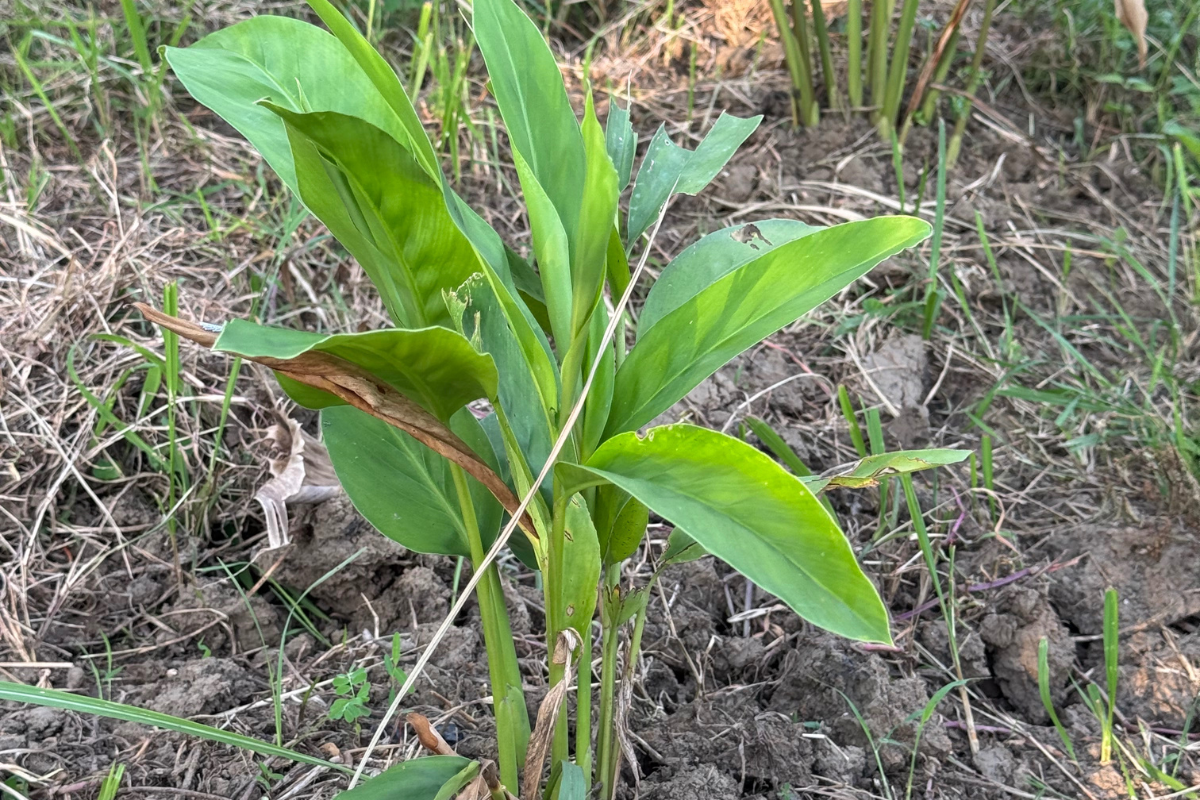
Turmeric (Curcuma longa) is a flowering plant in the ginger family Zingiberaceae. It is a perennial, rhizomatous, herbaceous crop widely grown in the tropical regions of South Asia. Turmeric thrives in warm temperatures between 20°C and 30°C and is highly valued for its culinary, medicinal, and economic uses.
In Nepal, turmeric cultivation is mainly concentrated in the Terai and lower hill regions, at elevations between 60 m and 1,200 m. Sunsari, Saptari, Rautahat, Surkhet, Sindhuli, Kailali, and Bardiya are among the major turmeric-producing districts.
Recent national statistics show a clear shift in turmeric production trends:
- 2077/78 (2020/21): 10,340 ha cultivated, producing 105,719 metric tons
- 2078/79 (2021/22): expansion to 10,847 ha, with production rising to 111,074 metric tons
- 2079/80 (2022/23): contraction to 9,022 ha and a drop in production to 90,428 metric tons
After two years of growth, the sharp decline in 2079/80 highlights increasing production challenges. In many turmeric-growing areas, farmers now report higher losses during wet seasons, with foliar diseases and premature plant decline becoming more common.
During the current season, farmers in Sunsari reported a 20%–30% reduction in turmeric production compared to the previous year. The main reasons mentioned were erratic rainfall in September and premature plant death, with many farmers unaware of the underlying causes.
The pattern of plant mortality observed under prolonged wet conditions aligns with symptoms widely reported for turmeric leaf blotch in South Asian countries.
What causes turmeric leaf blotch
Turmeric leaf blotch is caused by Taphrina maculans, a fungal pathogen that primarily infects leaf tissue and interferes with normal leaf growth and physiological function.
The fungus survives between cropping seasons on infected plant residues and can also be introduced into new fields through infected rhizomes used as planting material. Under warm and humid conditions, especially during periods of continuous rainfall, the pathogen develops and spreads rapidly. Prolonged leaf wetness creates ideal conditions for spore germination and penetration.
Environmental Conditions Favoring Disease Development
Disease development, penetration, and rapid spread occur particularly during periods of continuous rainfall under warm, humid environmental conditions. The favorable conditions for fungal infection include:
- High moisture on leaf surfaces: Extended leaf wetness periods allow fungal spores to germinate and penetrate plant tissues
- Dense crop canopy: Poor air circulation within densely planted fields creates microclimates ideal for pathogen proliferation
- Temperature range of 21-30°C: The fungus thrives in warm temperatures, with peak infection intensity occurring at 21-23°C coupled with 80% relative humidity
- High humidity levels (70-90%): While beneficial for turmeric growth, prolonged high humidity promotes airborne diseases like leaf blotch
According to research, a temperature of 25-30°C with high soil moisture and leaf wetness provides optimal conditions for Taphrina maculans infection.
Disease Transmission and Spread
The pathogen spreads mainly through wind-borne spores and rain splashes, which allow the fungus to move easily within fields and between neighboring plots. The fungus is primarily airborne, with primary infection occurring on lower leaves first. Secondary infections arise from ascospores released by maturing asci, which develop into octosporous microcolonies that infect fresh leaves without any dormancy period.
Studies indicate that secondary infections are generally more damaging than primary ones, leading to extensive spotting across leaves. The inoculum survives in dried leaves of hosts left in the field, and during summer, the pathogen persists through ascogenous cells on leaf debris and desiccated ascospores and blastospores in soils and among fallen leaves.
Why leaf blotch is a recurring problem
Several factors contribute to the recurring nature of leaf blotch in turmeric-growing areas:
- Frequent monocropping: Continuous turmeric cultivation in the same field without rotation increases disease establishment and buildup of inoculum in the soil
- Lack of field sanitation: Failure to remove infected plant residues allows the pathogen to persist between seasons
- Delayed removal of infected plants: Allowing diseased plants to remain in the field increases disease spread to healthy plants
- Use of infected planting material: Rhizomes from infected fields carry the pathogen to new locations
- Poor drainage and improper spacing: These conditions create favorable microclimates for disease development
Symptoms of leaf blotch in turmeric plants
Leaf blotch symptoms usually appear first on older leaves. Early symptoms include small brown to yellowish spots scattered across the leaf surface. As the disease progresses, these spots enlarge and merge, forming irregular brown blotches.
In advanced stages:
- Leaves lose their green color
- Drying begins from the tips and margins
- Affected leaves wither prematurely
Under severe infection, the disease can spread systemically within the plant, leading to early plant decline and eventual death. Similar symptom progression has been documented in Wikifarmer disease guides, where reduced photosynthetic area results in weakened plants and lower rhizome development.
Identifying symptoms
Early detection is critical for control. Symptoms typically progress in the following stages:
- Initial Stage: Small brown or yellowish spots (1-2 mm) appear on the first older leaves. These spots are scattered across the leaf surface, often appearing in rows along the veins.
- Progression: Spots gradually enlarge and merge (coalesce) to form irregular brown patches or "blotches."
- Severe Infection: Affected leaves lose their green color and begin to dry from the tips and margins.
- Advanced Stage: The plant acquires a scorched appearance and may wither prematurely. The infection can spread systemically, leading to significant yield loss and untimely plant death.
Smart and practical management solutions
Prevention is the first line of defense
Management of turmeric leaf blotch should focus primarily on prevention and timely field practices. Since infected planting material is a major source of the disease, the use of healthy, disease-free rhizomes is essential. Wikifarmer consistently emphasizes planting material quality as a foundation of disease management in rhizomatous crops.
Rhizome treatment with Trichoderma before planting can help suppress early fungal infection and support healthier root and rhizome development.
Field hygiene and crop management
Maintaining proper field sanitation by removing infected leaves and crop residues significantly limits disease spread. This practice is particularly important during the rainy season, when fungal spores spread more easily.
Proper plant spacing and good drainage reduce humidity within the crop canopy and limit prolonged leaf wetness. Wikifarmer articles on turmeric and ginger cultivation repeatedly highlight drainage as one of the most critical agronomic factors in high-rainfall regions.
Continuous turmeric cultivation in the same field should be avoided. Crop rotation with non-host crops helps reduce pathogen buildup in the soil and plant residues.
Chemical control when disease pressure is high
When disease pressure is high and early symptoms are observed, fungicide application may be considered to limit further spread. Copper-based fungicides are commonly used at early stages and can help reduce disease severity when applied correctly as part of an integrated disease management approach.
Chemical control should always complement, not replace, good agronomic practices such as the use of healthy planting material, proper drainage, adequate spacing, and field sanitation. Before applying any plant protection product, it is strongly recommended to consult a qualified agronomist and follow local regulations regarding approved active substances, dosage, and application timing.
Why leaf blotch matters for turmeric production
Unchecked leaf blotch reduces the functional leaf area, weakens plant vigor, and directly affects rhizome development. As highlighted in Wikifarmer production guides, foliar health is closely linked to final yield and quality in turmeric. Early identification and preventive management are therefore critical to reducing yield losses, especially in seasons with erratic rainfall.
References
Directorate of Extension, e-Agriculture. (n.d.). Turmeric: Major disease :: Leaf blotch. eAgri. TURMERIC :: MAJOR DISEASE :: LEAF BLOTCH
Government of Nepal, Ministry of Agriculture and Livestock Development. (2081 BS / 2024 CE). Statistical Information on Nepalese Agriculture, 2080/81 (Table on area and production of turmeric)
Turmeric. (n.d.). In Wikipedia. Wiki: Turmeric — Wikipedia