


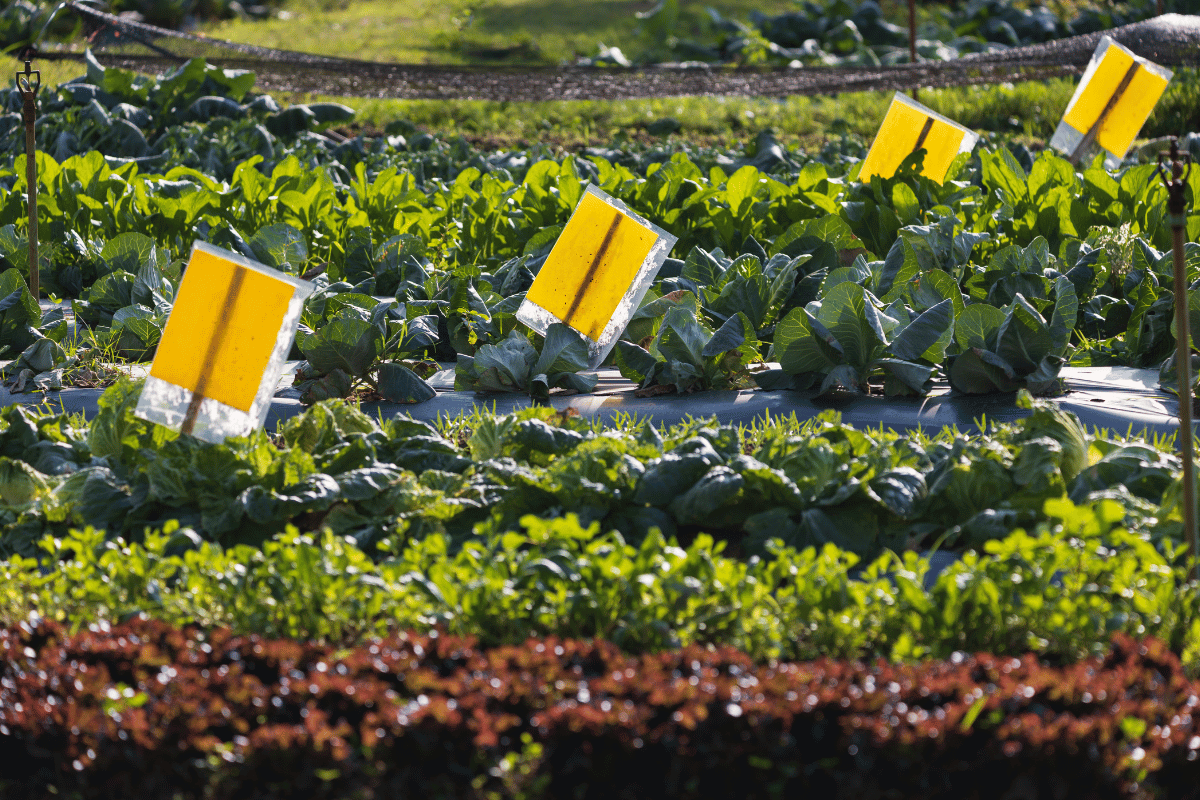
Most farmers know the term integrated pest management, but many miss how much it actually covers. Too often, I see growers fighting a pest by throwing whatever they can at it in the form of chemical sprays. Tomato growers dealing with Tuta absoluta are a good example. Tuta is extremely destructive, difficult to control, and gains resistance remarkably quickly, so nobody can blame growers for throwing everything at it. But if the only weapon in use is a chemical spray, is that really throwing the kitchen sink at the problem?
Plenty of farmers treat pheromone traps used purely for scouting, paired with an aggressive spray programme, as integrated pest management. Technically, it is. In practice, it barely scratches the surface of what IPM can achieve. Fully implementing it means attacking the pest on every front, using many different tools towards one goal, and by different tools, I do not only mean different chemical actives.
Trapping
Many of the farms I visit use trapping, and almost always for scouting. Scouting is genuinely valuable, but in most cases, you are trying to act proactively anyway, and trap counts tend to matter mainly once you have decided to bring out the big guns. Growers and advisors often dismiss the idea of increasing trap numbers because mass trapping in an open field is not foolproof. But does it have to be?
Imagine relying on a single chemical active for a whole growing season and expecting it to carry your pest management. Mass trapping can be capital-intensive, since 20 to 25 traps per acre is a real investment, but with the right traps, it is usually a one-off cost, with pheromone replacement the only recurring expense.
Do not expect mass trapping to wipe out the local pest population, because it will not. It will affect the adult population, disrupt mating and egg-laying, and serve as one of several tools you need to reach the goal of minimising damage. Mating disruption pheromones work along similar lines, reducing egg laying and interfering with adult populations.
Targeting different life stages
Trapping belongs in this category too, since it targets the adult, while most control efforts go to the larvae. Attention usually falls on whichever stage feeds on the plant, because that is the one visibly causing damage, when in fact most pests pass through egg, larval, pupal, and adult stages.
Take Tuta again. Growers are typically targeting the leaf-mining larvae, but what if we also aimed at the stage that lives in the soil, the pupa? Once larvae have fed their fill on tomato or potato leaves, they drop off the plant and pupate in the soil. In favourable conditions, adults emerge within five to seven days, and you have a fresh generation of moths mating and laying in your field, driving another wave of pressure. On longer-season crops such as indeterminate tomatoes, these compounds, and Tuta pressure can get badly out of hand.
So why not inoculate the soil with an entomopathogenic fungus, meaning one that infects insects, such as Beauveria bassiana or Metarhizium anisopliae? A study of soil-applied fungal biopesticides found high pupal mortality across all products tested, along with a significant reduction in fecundity among moths that survived to emerge. Does that make a Beauveria or Metarhizium drench a complete control method for Tuta, or a replacement for chemical sprays? Absolutely not. It is another tool contributing to the same goal of suppression.
Nutrition
Plant nutrition is the most overlooked aspect of pest control. Many farmers know that excess nitrogen raises pest pressure because of all the soft new growth it produces. That is not where nutrition stops mattering.
Balanced nutrition can make a crop less attractive to pests in the first place. Calcium is a good example. Foliar calcium sprays have been shown to reduce egg laying by western flower thrips on treated bean plants while making those plants more attractive to Orius, the pirate bugs that prey on the thrips (Huang et al., 2022). Potassium is another. Low potassium levels have been associated with heavier aphid infestations (Myers and Gratton, 2006), and higher potassium has been shown to improve tolerance to leafhoppers (Rashid et al., 2016).
Silicon, another nutrient that rarely gets attention, has been shown to increase resistance to planthoppers, though when nitrogen levels were too high, the protective effect was weaker, reinforcing the point about balance (Vu et al., 2022). Work on the soil microbiome points in the same direction, with optimised soil biology reducing the attractiveness of crops to insect pests, most likely through the balanced nutrient levels produced by biologically mediated nutrition (Ma et al., 2024).
Sprays are a tool, not the programme
Those are only some of the tools available within IPM. There are others worth exploring, including predatory and parasitic insects and antifeedants, but the ones above are, to my mind, among the most accessible and effective.
It is not always possible to replace chemical sprays, particularly on certain crops, though that is not to say it is impossible. It is possible to reduce them while more effectively controlling the target pest. Chemical sprays belong in the toolbox. They are not the whole pest management programme.
Sources
Erasmus, R., van den Berg, J., and du Plessis, H. (2021). Susceptibility of Tuta absoluta (Lepidoptera: Gelechiidae) pupae to soil applied entomopathogenic fungal biopesticides. Insects, 12(6), 515.
Huang, W. Q., Zeng, G., Zhi, J. R., Qiu, X. Y., and Yin, Z. J. (2022). Exogenous calcium suppresses the oviposition choices of Frankliniella occidentalis and promotes the attraction of Orius similis by altering volatile blend emissions in kidney bean plants. Insects, 13(12), 1127.
Myers, S. W., and Gratton, C. (2006). Influence of potassium fertility on soybean aphid, Aphis glycines Matsumura, population dynamics at a field and regional scale. Environmental Entomology, 35(1), 219-227.
Rashid, M. M., Jahan, M., and Islam, K. S. (2016). Impact of nitrogen, phosphorus and potassium on brown planthopper and tolerance of its host rice plants. Rice Science, 23(3), 119-131.
Vu, Q., Dossa, G. S., Mundaca, E. A., Settele, J., Crisol-Martínez, E., and Horgan, F. G. (2022). Combined effects of soil silicon and host plant resistance on planthoppers, blast and bacterial blight in tropical rice. Insects, 13(7), 604.