


Indonesia’s Commitment to SDGs: A Path Toward 2030 Goals
By Christina Julianti Siahaan
The Sustainable Development Goals (SDGs) to continue the Millenium development goals (MDGs) were established as the 2030 global agenda by the UN General Assembly in September 2015, which was attended by 159 heads of state, including the vice president of Indonesia (Sitorus, 2017). As one of the UN members, Indonesia is responsible for implementing the SDGs, which consist of 17 goals with 169 measurable achievements, and has agreed to implement them.
With only five years remaining to achieve the SDG targets in 2030, this writing will elaborate in a nutshell on how far the Indonesian government has worked toward the goals, what challenges arise, and the crucial factors to be taken into account for the success of implementing the SDGs.
Key Achievements: How Far Has Indonesia Come in Meeting SDGs?
The government of Indonesia is committed to achieving the SDGs goals by integrating them into the targets of the national medium-term development plan (RPJMN) in 2015-2019 and continuing it into RPJMN 2020-2024, the Government Annual Work Plan (RKP) at the national level, Regional Medium-Term Development Plan (RPJMD) and Regional Annual Work Plan (RKPD) along with their allocated budgets (Smeru research, 2023). Thus, the government's effort in synchronizing the SDGs and the RPJMN concludes that several SDGs (poverty, health, education, inequality, water and sanitation, and access to energy) are very much aligned with the targets of the RPJMN. Although the targets of gender equality, inclusive and sustainable economic growth and decent work, and sustainable consumption and production patterns were still limited.
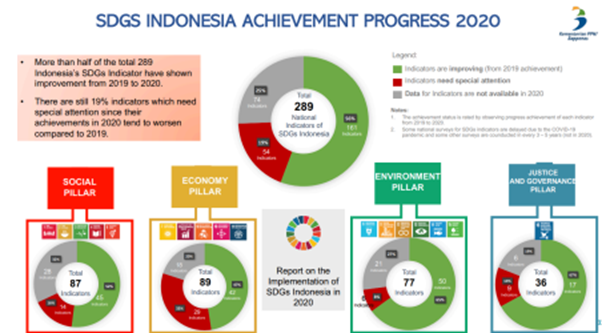
After implementing it for eight years, in 2023, the former minister of the national development planning agency (BAPPENAS, 2023), Suharso Monoarfa, stated that Indonesia’s SDGs achievement indicators have met 62 percent of the total evaluable targets so that this country is considered the most progressive in achieving SDGs in the upper middle-income country category. In detail, of the 224 indicators evaluated, 138 indicators were achieved, 31 will be achieved/improved, and 55 require special attention. Furthermore, the 2023 Sustainable Development Report stated that Indonesia's performance of SDGs rose from 102nd place four years earlier, showing improvement. Still, based on data from the 2023 Sustainable Development Report, Indonesia's score increased from 64.2 in 2019 to 70.2. Even though Indonesia's index score has increased by 6% points since 2019, many goals need to be achieved.
Major Challenges Hindering Indonesia’s SDG Progress
While this achievement is encouraging, the country still faces the challenge of reaching the full target by 2030. Some of the goals that are still challenging are non-starvation, clean and affordable energy, ocean and land ecosystems, peace, justice, and resilient institutions (Bappenas, 2023). These goals are somewhat stagnant and have faced major challenges that make them hard to achieve.
The Role of Geography in SDG Challenges
The major challenge is first the geographical condition of Indonesia, with 514 districts/municipalities, which has made it hard to achieve equality of development. Outside of Java Island, many provinces are still lagging in infrastructure, access to education, health facilities, public transportation, and many other public services. This inequality has affected the achievement of the SDGs goals in general, specifically related to poverty, non-starvation, clean energy, ocean and land ecosystems, peace, justice, and resilient institutions.
Climate Change and Environmental Barriers
Second, Indonesia is a country prone to disaster, facing extreme weather events and climate anomalies. This has made it hard to achieve the SDGs goals. Climate change and environmental damage are major challenges in achieving the SDGs related to environmental sustainability (KLHK, 2023). As one of the countries that is vulnerable to the impacts of climate change, such as floods, droughts, and forest fires, achieving the SDGs goals becomes harder without strong political will from the government.
The Role of Governance, Corruption, and Policy Implementation
Third is the factor of corruption and poor governance. These two crucial issues have become one of the biggest obstacles to achieving the SDGs in Indonesia. According to Indonesia's Corruption Perception Index, published by Transparency International in 2020, Indonesia ranked 102nd out of 180 countries surveyed as one of the countries with the highest levels of corruption in its bureaucracy, political institutions, and judiciary. The misuse of public budgets, non-transparent policies, and lack of accountability in using development funds have hindered the country from achieving sustainable development goals. In terms of poor governance, Indonesia's governance arrangements are not yet effective, as can be seen in its policy consistency. Even harder with the situation of Indonesia's complex government structure of 600+ jurisdictions, which mostly overlap, thus making it hard to achieve successful policy implementation.
Poverty and Socioeconomic Gaps
Fourth is the factor of poverty. This has become a major problem that has worsened since the COVID-19 pandemic, with a significant gap between urban and rural areas. Rural areas have a greater poverty rate than metropolitan areas. According to data from BPS, in March 2020, the urban poverty rate was 7.38% (11.16 million people), but the poverty rate in rural areas was almost twice as high, reaching 12.82% (15.26 million people).
The Road Ahead: Strategies to Achieve SDGs in Indonesia by 2030
There are other challenges to assessing progress on implementing SDGs in Indonesia. However, those four are the main problems based on the publication in journals and the media. To achieve the SDGs goals, which last five years, Indonesia needs to decrease the poverty rate, reduce corruption, improve the quality of education, improve governance, manage natural resources sustainably, and improve infrastructure that supports sustainable development.
Having said that, it would be a very challenging task to achieve the 17 SDGs by 2030. To make it happen, it will need strong collaboration between stakeholders supported by innovative financing and to separate between the targets of the SDGs indicators at the National and Regional levels. By giving powers and responsibilities to local governments, countries can create systems that are more responsive to the needs of local communities, strengthen public participation, and support inclusive and sustainable economic growth; thus, in the end, will help to achieve the SDGs goals by 2030.
References:
BAPPENAS. (2021, December 12). Roadmap of SDGs Indonesia toward 2030. DKI Jakarta, DKI Jakarta , Indonesia.
Dewi, R. K. (2021). Strengthening Framework of Implementation of Sustainable Development Goals (SDGs). DKI Jakarta: Smeru Research .
Kadek, Ni Kadek Eka. “Implementation of the Sustainable Development Goals (SDGs) Program in Indonesia: Literature Review Analysis.” IRJEMS International Research Journal of Economics and Management Studies, vol. 3, no. 1, 2024, p. 12. No: 497-502, IRJEMS Vol. 3 Issue 1 (PDF).
KLHK. (2023, July 10). Potret Capaian SDGs menuju 2030. Jakarta, DKI Jakarta, Indonesia.
Sitorus. (2017). INTEGRASI PENDIDIKAN KEPENDUDUKAN KEDALAM KURIKULUM DALAM RANGKA PENCAPAIAN TARGET SUSTAINABLE DEVELOPMENT GOALS (SDGs) DI INDONESIA. Seminar Nasional Tahunan Pendidikan Ilmu-Ilmu Sosial (p. 4). Medan: University of Medan (UniMed).