


Setiawan Guntarto
Why Most Agritech Startups Fail: Lessons from Indonesia’s Poultry Sector on Building Farmer-First Solutions
Introduction: Why Many Agritech Startups Miss the Mark
In 2020, I believed IoT and sensor-based solutions could transform poultry farming in Indonesia. Coming from an internal audit and analyst role at Japfa, one of Southeast Asia's largest integrated poultry companies, I saw firsthand how inefficiencies and opacity in the midstream value chain, particularly in contract farming, hurt farmers and companies. This inspired me to join agritech startups like Chickin and later BroilerX, where I led product development to bridge data gaps, automate weight monitoring, and offer precision farm analytics.
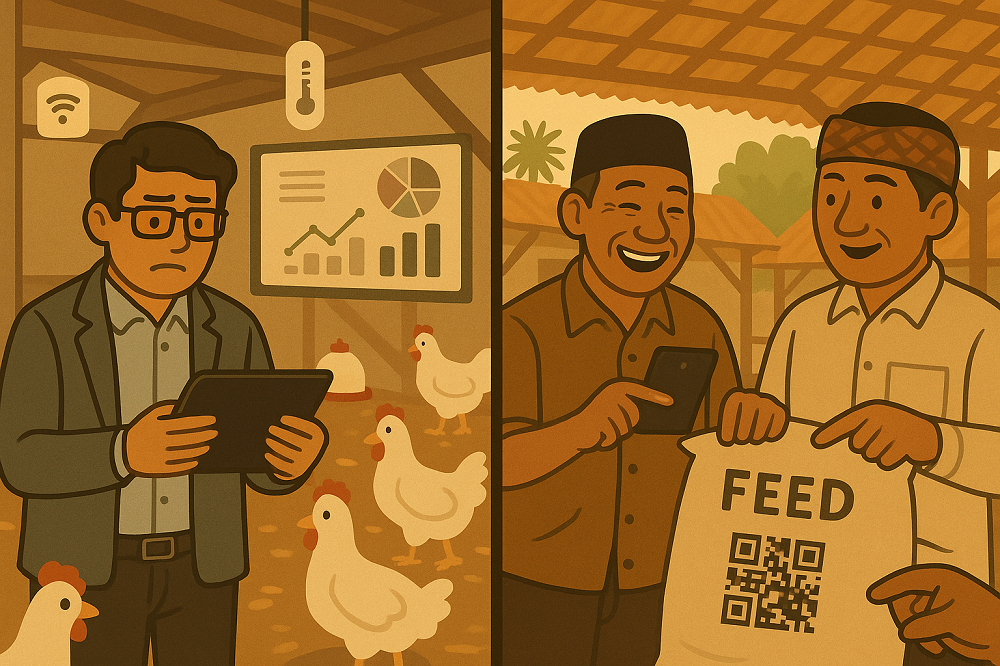
But reality hit hard. Despite the promise of smart poultry sensors, adoption was slow. Farmers hesitated—not because they feared technology, but because they were overwhelmed by more basic, unresolved issues: mortality rates, inconsistent chick quality, volatile feed prices, and distrust in opaque settlement systems. Many lacked formal education beyond junior high. Asking them to use apps in English or connect hardware to cloud systems was not just impractical—it was detached from their daily pain.
This article reflects on my journey, our mistakes in chasing innovation, and the lessons I learned. Agritech can be transformative, but only if it starts from the ground: culturally relevant, margin-sensitive, and farmer-trusted.
Three Barriers That Kill Good Technology in the Field
1. Social and Educational Diversity
Indonesia’s agricultural base is socially diverse. Many farmers have little formal education, and most are unfamiliar with digital applications, especially those in English. At BroilerX, we quickly learned that QR codes printed on feed bags and WhatsApp-based reporting outperformed mobile apps. These low-tech tools aligned with farmers' habits, literacy, and comfort levels. It wasn’t a lack of willingness to adapt—it was the disconnect between design and user reality.
2. Purchasing Power and Risk Aversion
Smallholder farmers operate under severe margin pressure. When we pitched tech subscriptions, many walked away. The average farmer in commercial broiler systems works on thin profits and cannot afford to gamble on tools they do not fully understand or control. According to Grow Asia (2020), CAC in many agritech models often exceeds LTV due to low repeat usage and high churn—especially when solutions ignore cost-benefit clarity.
3. Mismatch with Daily Pain Points
We built dashboards, cloud analytics, and real-time monitoring. But what farmers asked for was more immediate: reliable chick quality, lower feed costs, and payment transparency. At Japfa, where the scale reached 600 million DOCs annually, internal audits often revealed friction in the most basic areas: chick distribution, mortality reporting, and weight discrepancies. Tech that does not solve these core frictions is a luxury, not a solution.
Designing for Margins and Mindsets: A Practical Framework
A. Start With Farmer Pain—Not Investor Trend
Effective agritech begins with listening, not pitching. At BroilerX, we shifted from predictive analytics to solving manual weight verification using QR-linked cards and cooperative field officer scans. Adoption rose not because of tech sophistication but because we fixed a trust issue. Innovation begins where friction lives.
B. Simplify Everything: Literacy and Familiarity Come First
ADB (2023) noted that 40% of digital rural projects fail due to misalignment with user capabilities. We found this painfully true. Farmers trusted paper records, verbal confirmations, and phone calls. By integrating WhatsApp-based systems with cooperative data protocols, we lowered the entry barrier dramatically. Tools should be light, multilingual, and offline-first.
C. Earn Trust Before Monetizing
Trust is not built-in pitch decks; it is earned in the field. In Chickin and BroilerX, partnering with respected cooperative leaders and providing free trials created a safer space for adoption. FAO (2022) highlights participatory tech introduction as 2.3x more effective than top-down rollouts. This matched our experience: early-stage farmers only adopted when someone they trusted used it first.
A Better Ecosystem: Rethinking Scale, Success, and Support
What I learned from Japfa's national-scale operation and later from startups is that the ecosystem is broken at its assumptions. Tech is not a silver bullet for systemic inefficiency—and many startups chase novelty at the cost of usability.
Governments must shift support to cooperatives and field-based experimentation. Incubators should stop glorifying MVPs and start prioritizing actual pain resolution. Investors need to reward resilience, not just revenue graphs. When we measure success by whether a tool works at a 3% margin and builds trust across literacy levels, we'll finally start solving real problems.
Conclusion: Innovation Is Empathy at Scale
Agritech must be built with farmers, not just for them. My journey taught me that rapid adoption doesn't come from sensors or IoT—it comes from solving unsexy, daily issues with respect for local context. If it doesn't work at 3% margin, and if it doesn't feel like an extension of the farmer's habit, it will fail. Innovation is not about technology; it’s about empathy, trust, and embedded change.
Looking forward, I would encourage startups to think beyond tools that just monitor or automate. There is a major opportunity to build tools that help farmers learn. Many farmers still rely heavily on field officers for instruction. A digital solution that documents and explains working procedures in simple,
localized formats—such as videos, audio, or visual guides—can help farmers retain and revisit knowledge even when the field officer is not around. With more young farmers entering the sector, we have the chance to cultivate a new generation of more informed, adaptive, and independent farmers than ever before.
References:
AgFunder. (2025). AgriFoodTech Investment Report 2025.
Grow Asia. (2020). Smallholder AgriTech Business Models: High-Potential Models Emerging in Southeast Asia.
ADB. (2023). Indonesia Tech Startups: Voices from the Ecosystem.
FAO. (2022). The State of Food and Agriculture: Leveraging Agricultural Automation for Sustainable Development.
Field insights from BroilerX, Chickin, and Japfa operations (2017–2025).