


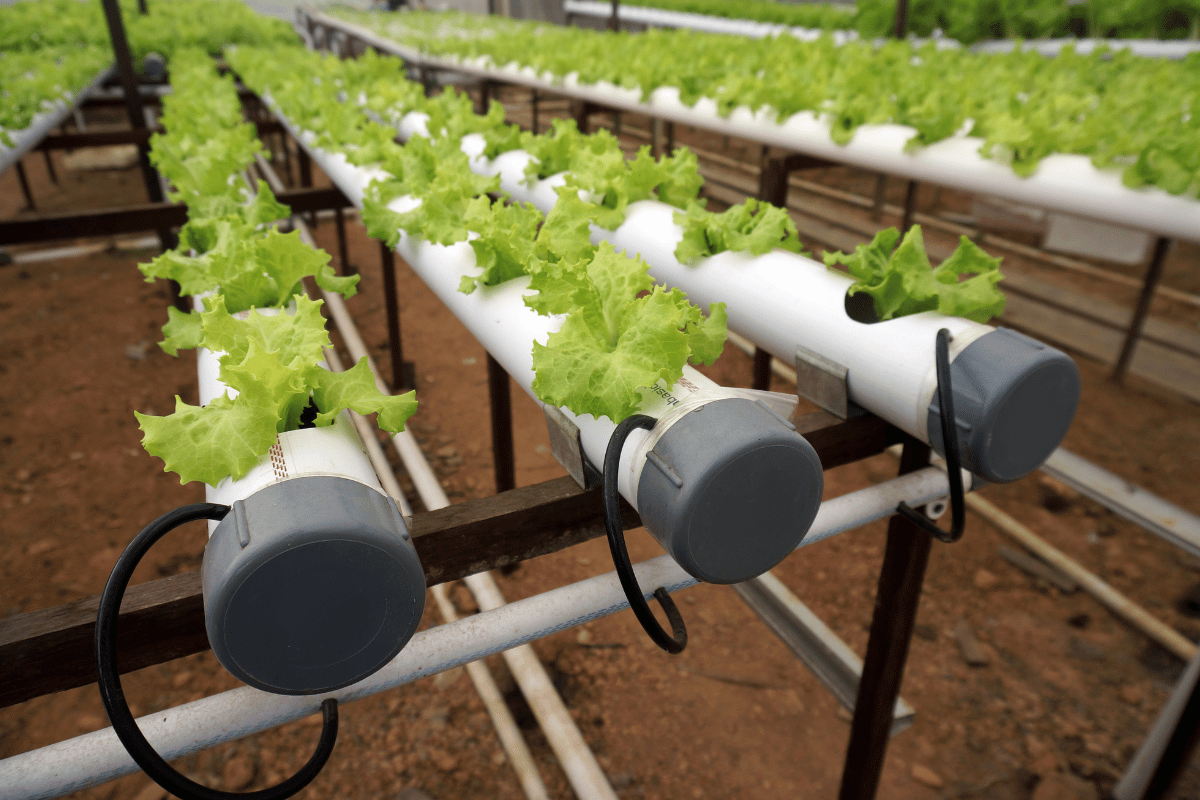
Agriculture accounts for roughly 70% of global freshwater withdrawals. In arid and semi-arid regions, where rainfall is already limited, this dependence puts enormous strain on water supplies. Countries across the Middle East, North Africa, and sub-Saharan Africa face growing tension between the water needed for farming and the water available for people to drink. As droughts become more frequent and aquifers decline, the way we grow food has to change. Hydroponic farming offers one of the most practical paths forward.
Why water scarcity is intensifying
The pressure on freshwater is not coming from one direction. The IPCC's Sixth Assessment Synthesis Report (2023) projects that arid regions will experience 10 to 30% less precipitation by mid-century under moderate warming scenarios. At the same time, the global population is expected to reach 9.7 billion by 2050, according to the United Nations, and food demand is projected to rise by roughly 50%.
Traditional open-field irrigation compounds the problem. Flood and furrow methods, still common in many water-scarce countries, can lose 40 to 60% of applied water through evaporation, surface runoff, and deep percolation below the root zone. Even when farmers adopt drip irrigation, field-level efficiency rarely exceeds 90% because soil itself absorbs and redistributes water in ways that are difficult to control. The fundamental issue is that soil acts as a middleman between the water source and the plant root, and that middleman takes a large cut.
How hydroponics reduces water consumption
Hydroponic systems remove soil from the equation entirely. Plants grow with their roots submerged in or periodically exposed to a nutrient-rich water solution. Because the water circulates in a closed or semi-closed loop, very little is lost to the environment. The only significant water exits are plant transpiration (which is unavoidable and productive, since it drives nutrient uptake) and minor evaporation from reservoirs.
The numbers bear this out. Research published in the journal Water (Barbosa et al., 2015) found that hydroponic lettuce production used approximately 13 times less water per kilogram of yield than conventional field lettuce. A 2020 study from the University of Arizona measured water savings of 80 to 90% for hydroponically grown tomatoes in a desert greenhouse compared to open-field production. These are not marginal improvements.
The reason for such efficiency is control. In a hydroponic setup, growers can measure and adjust the electrical conductivity (EC) and pH of the nutrient solution in real time, delivering exactly what each crop needs at each growth stage. There is no guesswork, no watering a whole field to reach the plants that need it most. Several types of hydroponic systems exist, from deep water culture to nutrient film technique, and each offers different advantages depending on the crop, climate, and available resources.
A telling comparison: water per kilogram of produce
One way to grasp the scale of savings is to compare water use per kilogram of harvested crop. Conventional field-grown lettuce typically requires 200 to 250 liters of water per kilogram. Hydroponic lettuce in a controlled environment can bring that figure down to 15 to 20 liters per kilogram. For tomatoes, field production averages about 150 to 200 liters per kilogram, while hydroponic greenhouse tomatoes can use 30 to 50 liters. These differences are what make hydroponics particularly relevant in countries like Jordan, where renewable freshwater availability is below 100 cubic meters per person per year, well under the absolute scarcity threshold.
Advantages beyond water savings
The benefits extend beyond reduced consumption. Hydroponic crops often grow 20 to 30% faster than their soil-grown counterparts because roots have uninterrupted access to nutrients and oxygen. Vertical farming setups, which stack hydroponic layers vertically, can produce significantly more food per square meter than open fields, making them suitable for urban areas where land is scarce and expensive. Growers working in deserts or regions with degraded or saline soils can bypass poor growing conditions entirely, since the growing medium is independent of local soil quality.
Pest and disease pressure also tends to be lower in enclosed hydroponic systems because there is no soil to harbor pathogens like Pythium or root-knot nematodes. This can reduce or eliminate the need for chemical pesticides, lowering both costs and environmental impact.
Limitations worth understanding
Hydroponics is not a universal fix, and overstating its benefits would be misleading. Setup costs represent the most significant barrier. A basic small-scale system might cost $1,000 to $5,000, while commercial greenhouses with automation and climate control can run into hundreds of thousands of dollars. In low-income countries where water scarcity is most severe, this capital requirement is often prohibitive without subsidy programs or development financing.
The systems also demand reliable electricity. A pump failure lasting even a few hours can kill an entire crop, since roots with no moisture buffer will dry out quickly. In regions with unstable power grids, backup generators or solar arrays add further expense.
Technical knowledge is another hurdle. Managing nutrient concentrations, pH levels, and environmental conditions requires training that many smallholder farmers in water-scarce regions currently lack. Extension services and beginner-level educational resources are expanding, but the gap remains wide in many areas.
Finally, not all crops are well-suited to hydroponics. Leafy greens, herbs, tomatoes, cucumbers, and strawberries perform well. Staple grains like wheat and rice, root vegetables, and tree crops are generally impractical in hydroponic systems at current technology levels.
Moving toward practical adoption
For hydroponics to make a real difference in water-scarce regions, three conditions need to be met. First, initial costs must come down through local manufacturing, standardized system designs, and financing mechanisms for smallholder farmers. Second, governments and development organizations need to integrate hydroponics into agricultural water-use strategies alongside soil- and water-conserving irrigation methods, rather than treating it as a niche technology. Third, practical training programs should be built into agricultural extension services so that farmers can maintain and troubleshoot their systems independently.
Countries like Saudi Arabia, the UAE, and Israel are already investing in hydroponic and controlled environment agriculture as part of national food security strategies. Jordan's National Agricultural Research Center has piloted hydroponic greenhouses in the Jordan Valley with promising results for water savings and income generation. These examples suggest that scaling up is possible when political will and investment align.
Conclusion
Hydroponic systems will not replace field agriculture, but in regions where every liter of water matters, they offer a practical route to producing more food with far less water. The technology is proven, the water savings are well-documented, and the range of suitable crops continues to grow. The remaining challenges are economic and institutional, not technical. With the right support structures, hydroponics can become a standard tool for sustainable agriculture in water-scarce areas.
References
- Barbosa, G. L., et al. (2015). Comparison of land, water, and energy requirements of lettuce grown using hydroponic vs. conventional agricultural methods. International Journal of Environmental Research and Public Health, 12(6), 6879-6891.
- FAO. (2024). World Food and Agriculture: Statistical Yearbook 2024. Rome: Food and Agriculture Organization.
- IPCC. (2023). Climate Change 2023: Synthesis Report. Contribution to the Sixth Assessment Report. Geneva: IPCC.