


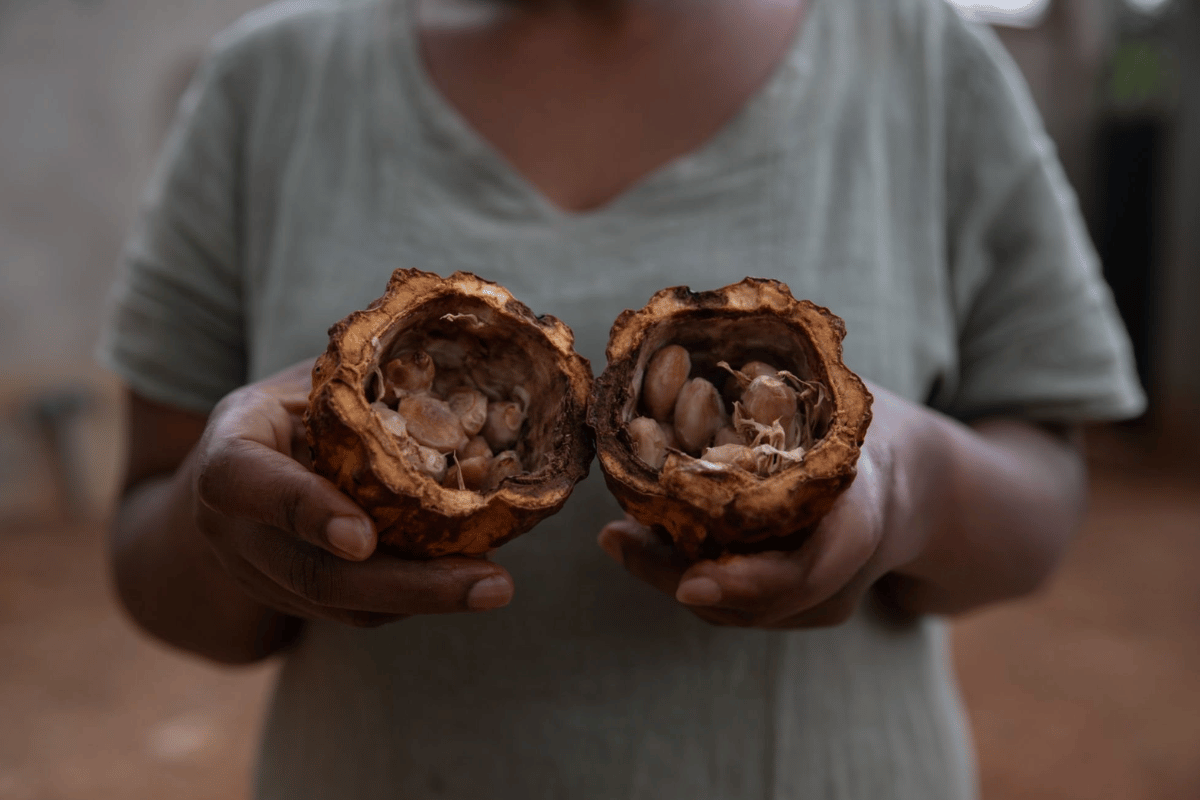
Cote d'Ivoire, Ghana, Nigeria, and Cameroon supply over 70 % of the world's cocoa. That is common knowledge. What is not common knowledge is the lack of chocolate available in Africa itself, the very continent that grows it.
There is little investment in local processing and no serious commitment from governments to change that. Yet this same cocoa is what built nations. Nigeria is a study in that truth. In the 1960s, Nigeria was the second largest producer of cocoa in the world, and cocoa was her highest source of foreign exchange before the deviation that oil brought with it. Cocoa delivered then. It has always delivered.
I know this not from a textbook but from the soil beneath my feet. I am Ajayi Ademola, a young farmer from South Nigeria, where cocoa does not just grow, it thrives. My family has farmed cocoa for three generations before me. It is not just a crop. It is a trade, a gift, and a legacy passed down through my bloodline to my hands today.
Yet despite all of this, the farmers who grow the world's cocoa face severe livelihood challenges. The cost of chemicals, labour, and farming tools keeps rising while the prices we receive do not follow. What makes it worse is the extreme volatility of cocoa prices on international markets. In late 2023, cocoa traded at around $4,200 per ton. By mid-2024, it had exploded past $11,000, a level not seen in nearly half a century. Then came the crash. By late 2025, prices had fallen back to around $4,000 per ton. These prices are not set by farmers. They are driven by international speculation thousands of miles away from our farms, and we bear the full weight of every rise and fall.
Africa must not only provide the produce to the world, it must claim the opportunities that grow from it. Cocoa has not failed Africa. Africa has not yet fully committed to cocoa.
Why selling raw cocoa keeps farmers poor
As I write this it is a burning time for cocoa farmers across Africa, but I believe this is also the best time for change.
Poor is an understatement for what farmers in Africa are experiencing right now. We are debtors. This year alone I have sent workers home three times because I could not cope with labour costs. Wages do not decrease when cocoa prices fall, but our income does. And the worst part is we do not even know how low prices will go. I have personally sold cocoa at $0.74 to $1.10 per kilogram, roughly $1,000 per ton. This is not a made-up story. This is the current reality of a cocoa farmer in Africa right now.
Let me put that into perspective. That same ton of cocoa that leaves our hands for roughly $1,000 is worth $8,000 per tonne just as a raw export. Process it into cocoa butter and the value multiplies six times. Turn it into chocolate and it rises to thirty times the raw export value. This is not speculation. John Alamu, founder and Group Managing Director of CapitalSage Holdings, made this point clearly when speaking about Africa's untapped processing potential. The bean is worth a fortune. Africa just keeps giving it away at the cheapest price.
Interest rates increase yearly. Labour costs rise. Inflation drives up the price of tools and chemicals, especially across cocoa-producing nations in Africa with growing economies. These are the first reasons a farmer who sells raw cocoa will remain poor. When you subtract expenditure from revenue as a farmer, you are literally left with nothing.
We are the lowest paid in the entire chain, doing the hardest work with no minimum wage, no safety net, and no guarantee. After selling to the middlemen we are left feeling abandoned. The big players in this industry, the exporters, the traders, the multinationals, do not care about the farmer. I am safe to say that. It is starting to look less like business and more like exploitation.
I know a farmer, a dedicated man who travelled consistently from Mushin, Lagos through Ogun State all the way to Ife South just to tend his cocoa farm. After consistently selling at $0.74 per kilogram he stopped coming regularly. Not because he stopped caring. But because the numbers stopped making sense. Is that fair? It is not. Many farmers across Africa are in the same pain, and if nothing changes, many more will soon give up.
The situation is made worse by global market conditions. Farmers in Cote d'Ivoire and Ghana have faced the inability to sell their cocoa due to ample global harvests, falling cocoa prices, and declining demand from chocolate makers. The raw cocoa farmer sits at the lowest point of the entire global supply chain, the most exposed, the least protected, and the first to suffer when prices fall.
Selling raw cocoa exposes farmers to price fluctuations they cannot control and cannot escape. This alone is the most valid reason to push for local processing in Africa.
But this conversation must go beyond cocoa-producing countries. Cocoa processing in Africa is a win for every African nation. There is no country on this continent that prohibits the consumption of cocoa. Countries with the capacity and resources should invest in cocoa processing. It will boost intra-African trade, strengthen economies across the continent, and create industries where there were none.
Value addition must become the mandate. Africa should also invest in research to uncover more benefits of cocoa beyond chocolate, exploring its use in cosmetics, medicine, and nutrition. Government policies must be put in place to support local processors, protect farmers, and attract investors into the cocoa value chain.
This is not just an opportunity for cocoa farmers. This is an opportunity for all of Africa.
What local processing needs
The first requirement is not infrastructure. It is not funding. It is not technology. It is determination.
There are many excuses made about the lack of infrastructure in Africa, but I believe that is exactly what they are. Excuses. We have what we need to start. What we need is the demand for processing to be so strong that infrastructure has no choice but to follow. That said, proper planning is critical. Rushing into processing without research and clear decisions will only push us back to square one.
I am a cocoa farmer who has never personally experienced local processing, and that says everything. I hear about it. I know it exists in places. But I have never felt it. There is a processing facility in Osun State but it is not enough. There is a big gap, and that gap is an open invitation for investors who are serious about Africa's future.
The middlemen buy from farmers like me. Some of them sell to processors. But they do not have the capacity to process everything, and what little processing exists does not reach back to the farmer. We grow it. We sell it cheap. And then it disappears into a chain we have no part of.
I will be honest. I dream of building my own processing facility. Not for profit alone, but to stand as hope for other farmers and encourage them to keep going. But it looks practically impossible right now. Capital is the wall. Processing is expensive. Beyond just the money, there are standards to meet, government support that does not exist, and high interest rates with no relief in sight. I am stuck in the volatility with no guaranteed future, and that gap between my dream and my reality is the same gap that exists between Africa and a thriving cocoa economy.
Yet I know what it would mean if that wall came down. It would change the entire landscape of agriculture in Africa, not just cocoa but every crop yearning for the same transformation. It would create jobs. It would build a future so bright that even students would dream of becoming cocoa farmers. It would put the industry in the hands of insiders, people who love this land, love this crop, and have given their lives to it.
It would put Africa beyond joy.
Countries that are making progress
Cote d'Ivoire stands out as the clearest example of what commitment to local processing looks like. As the world's leading cocoa producer, responsible for roughly 45 % of global supply, it has transformed itself into a major grinding hub. With approximately 14 processing and chocolate factories, an installed capacity of over 777,000 tonnes per year, and a $233 million grinding factory in Abidjan with a capacity of 50,000 tonnes per year, Cote d'Ivoire is proof that Africa can build world-class processing infrastructure. The government has set a target to process at least 50 % of its cocoa domestically within the next two years. Every tonne processed locally adds an estimated $900 to $1,200 more in value than exporting it raw.
When I look at all of that as a Nigerian farmer, everything feels backward. Not backward in a defeated way. Backward in a way that makes you want to move.
Nigeria was once the second largest cocoa producer in the world. We had that. And then government neglect set in. The same government that was once spearheading cocoa sustainability and farmers' empowerment stepped back, and oil took over the conversation. We lost our place and we have been trying to find it ever since.
There are processing plants in Nigeria. Ile-Oluji Cocoa Processing Company, Olam Cooperative Cocoa Industry, and Stanmark Cocoa Industry in Ondo State. Ede Cocoa Processing Company in Osun State. Tulip Cocoa Processing Company in Ogun State. They exist. But the truth is that most farmers have never heard of them. I only know because I am curious. Because I research. Because I refuse to just farm without understanding the world my cocoa enters. The average farmer in South Nigeria does not know these facilities exist, and some of them may even be struggling themselves.
That disconnect, between the farmer who grows the cocoa and the facility that could process it, is one of the most overlooked failures in Nigeria's agricultural system. These plants should be reaching back to farming communities. Farmers should know their names, their locations, and how to supply them directly without a middleman in between.
But I have not given up on Nigeria. I am working. I will continue to work. Nigeria has the history, the soil, the farmers, and the hunger for change. Now is the time. The hopes of cocoa farmers must not be dashed.
Practical steps forward
This section is not for researchers. It is not for analysts. It is a direct message from a cocoa farmer to every person with the power to change this industry.
To governments: Build processing facilities. Offer concessions. Actively seek partners. You will find them. But they need commitment from you before they can commit. Do not just build factories. Build storage facilities too. Strengthen the cocoa board not to regulate prices but to act as an active market participant. Be involved. A win for farmers is a win for your countries. Let us take this bull by the horn and finish the job.
To investors: I know you need government assurance. But you have forgotten the farmer. We are here. We are ready. We are behind you and we will not let you down. Irrespective of where you come from, call this place home. We will consistently produce, consistently collaborate, and consistently show up. The land is ready. The farmers are ready. Are you?
To development banks: You are not trying hard enough, and I say that with respect. There is structural deficiency in how your support reaches farming communities. You can do more. Collaborate with governments. Lobby for progressive policies. If the structures around you prevent you from working effectively, speak out. You are in that office to effect change and that is exactly what you must do. Your work is not getting to the grassroots. The structure must be cut down to serve the small farmer, the one earning $0.74 per kilogram with no relief in sight.
To chocolate companies: Give fair value for this product. Between you and the farmer, it is clear that you do not. But I will not place all the blame on you because the system was built this way long before either of us arrived. What I ask is that you comply with the changes that are coming. They are coming. You are our biggest customers and our relationship should be close, friendly, and built on mutual respect. Any inconsistency in the quality of cocoa butter, powder, or chocolate cannot be resolved without relationship. Build that relationship. Let farmers receive not just fair value for their produce, but respect for it.
To Africa: The African Continental Free Trade Area (AfCFTA) exists. Use it. Processed cocoa made in Ghana, Nigeria, or Cote d'Ivoire should move freely across this continent. We should be each other's biggest customers before we look outward. Invest in research. Cocoa is more than chocolate. It has applications in cosmetics, medicine, and nutrition that Africa has barely begun to explore. The opportunity is bigger than any of us have imagined.
Conclusion
This is not a fight against access to cocoa by the international chocolate market. It is a drive to make things right.
For too long Africa has watched her most valuable crops leave her shores raw and return as finished products at prices her own farmers can never afford. For too long the farmer who wakes before sunrise, tends the land through heat and rain, and delivers the raw material that feeds a billion-dollar industry has been the least rewarded person in that chain. Enough of that. Enough of backwardness in agriculture in Africa.
I am Ajayi Ademola. A young farmer from South Nigeria where cocoa does not just grow, it thrives. Three generations of my family farmed this crop before me. It is not just a crop. It is a trade, a gift, and a legacy. And it is because of that legacy that I refuse to accept that this is how the story ends.
This article is not the end of the conversation. It is the starting point.
We will continue to feed the world, and grow the capacity to feed ourselves.