Introduction
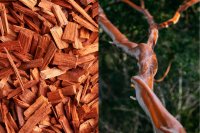
Sandalwood (Santalum album L.) is one of the most valuable trees grown in India, prized for its fragrant heartwood and oil. For farmers, knowing how much heartwood is present in their standing trees is essential for making decisions about harvesting and maximizing profits. Traditionally, this meant cutting down the tree—often before it reached its full value. However, a modern, non-destructive technology called Electrical Resistance Tomography (ERT) now allows farmers to estimate heartwood content without harming the tree.
This guide explains how ERT works, why it’s a game-changer for sandalwood growers, and how it can be used on your farm.
Understanding Heartwood and Sapwood
Inside every sandalwood tree, there are two main types of wood: sapwood and heartwood. Sapwood is the outer, living part of the trunk that carries water and nutrients. Heartwood forms in the center as the tree ages; it is denser, drier, and contains the valuable oils that make sandalwood so sought after. The challenge for farmers has always been to estimate how much heartwood is inside a tree—without cutting it down.
What is Electrical Resistance Tomography (ERT)?
ERT is a scientific method that measures how easily electricity can pass through different parts of a tree trunk. By inserting small electrodes into the surface of the trunk, ERT can “see inside” the tree and create a detailed image of its internal structure1.
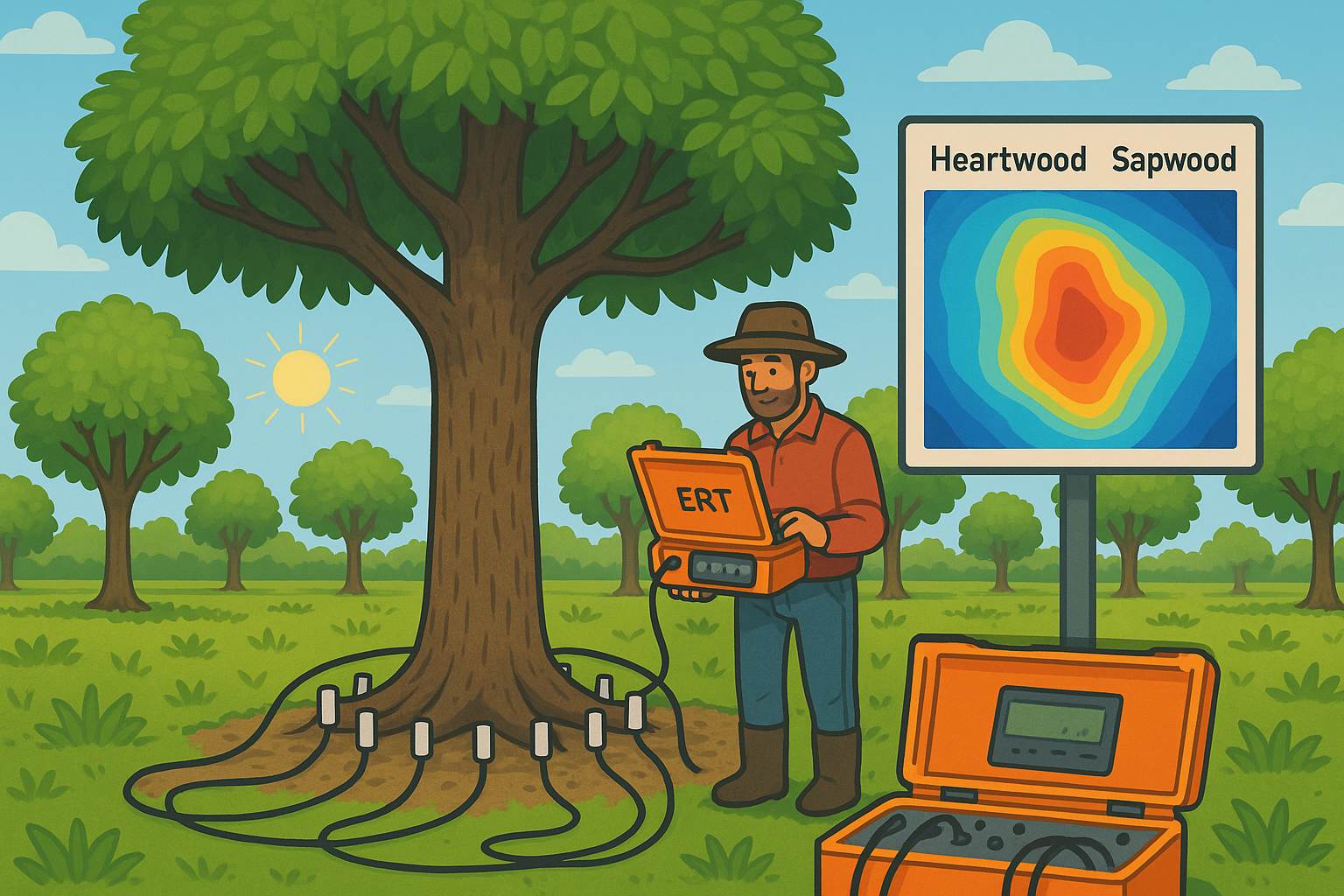
The principle is simple: sapwood, which contains more water, conducts electricity better and has lower resistance. Heartwood, being drier and denser, has higher resistance. By mapping these differences, ERT shows exactly where the heartwood and sapwood are located.
How ERT Works in Practice
The process starts by measuring the tree’s girth at chest height, typically 1.37 meters above the ground. Depending on the size of the tree, between 8 and 24 small nails (electrodes) are inserted evenly around the trunk at this height. These electrodes are connected to the ERT device, which sends tiny electrical signals through the wood and records how much resistance it encounters at each point.
The device then generates a color image—called a tomogram—showing the internal structure of the tree. In these images, blue typically indicates areas of low resistance (wet sapwood), while brown shows high resistance (dry heartwood). The boundary between these colors helps you see how much of the trunk is heartwood and how much is sapwood.
The ERT device is lightweight, portable, and designed for use in the field. It can store up to 120 scan files and works reliably in different weather conditions, making it suitable for on-farm use.
Interpreting ERT Images
After scanning, the ERT device displays a graphical representation of the tree’s internal structure. The images are easy to interpret:
- Blue: Indicates sapwood with high water content and low resistance.
- Light Blue: Shows normal sapwood with moderate water content.
- Yellow: Represents wood with slightly less moisture.
- Red: Marks areas of high resistance, usually drier heartwood.
- Brown: Indicates the driest, densest heartwood with the highest resistance.
These color patterns allow you to clearly see the heartwood-sapwood boundary and identify any internal defects such as decay or hollowness.
For more detailed analysis, the images can be uploaded to a computer using special software. This software can create both 2D and 3D images, giving you an even clearer picture of the heartwood distribution inside the trunk.
Accuracy and Benefits for Farmers
Field trials in Karnataka have shown that ERT estimates of heartwood content in standing sandalwood trees are 80–90% similar to actual measurements taken after harvesting1. In healthy sandalwood trees around 12 years old, sapwood typically shows resistance values between 200–300 ohms (Ω), while heartwood measures between 500–800 Ω. These values can help you distinguish between wood zones and assess the quality of your trees.
The advantages of ERT for farmers are significant:
- Non-destructive: You can assess heartwood without cutting down or damaging the tree.
- Fast and efficient: Scanning and analysis take only a few minutes per tree.
- Portable: The equipment is easy to carry and use in the field.
- User-friendly: The images are clear and simple to interpret, even for those without technical training.
- Tree-friendly: The process does not harm the tree, so you can continue to monitor its growth and health over time.
Using ERT on Your Farm
The Institute of Wood Science and Technology has pioneered the use of ERT for tropical trees like sandalwood. They now offer consultancy services for ERT-based heartwood estimation, working with farmers, forestry officials, and other stakeholders. This service is especially valuable for those managing high-value timber species.
To use ERT on your farm, a minimum of 50 trees should be available for testing per day. The cost for each sample is Rs. 236 or Rs. 1180, depending on the scheme. Consultancy, travel, and other expenses are typically covered by the farmer, unless the testing is done under certain government programs, which may waive these charges.
Farmer Training and Extension Activities
As part of ongoing extension efforts, selected farmers have been trained in heartwood formation and the use of ERT. During these sessions, farmers received ERT images of their own trees, helping them understand internal tree health and monitor heartwood development. This hands-on approach empowers farmers to use modern technology for better plantation management and sustainable harvesting.
Real-World Impact
Farmers and forestry departments across India are already benefiting from ERT technology. Notable users include the Chhattisgarh and Karnataka Forest Departments, as well as progressive farmers and private plantations. By integrating ERT into their management practices, these stakeholders are making more informed decisions about when to harvest and how to care for their trees, ensuring higher returns and healthier plantations.
Conclusion
Electrical Resistance Tomography (ERT) is transforming the way sandalwood farmers estimate heartwood in their trees. With its non-destructive approach, high accuracy, and ease of use, ERT helps you unlock the full value of your sandalwood crop while supporting sustainable forestry practices. If you’re interested in adopting ERT on your farm, contact your local forestry office or the Institute of Wood Science and Technology for more information about consultancy and training opportunities.
By embracing this technology, you can make smarter decisions, protect your investment, and contribute to the future of sustainable sandalwood farming.
This work was supported by the Ministry of Environment, Forest and Climate Change (MoEFCC), New Delhi, under the project “Strengthening Forestry Research for Ecological Sustainability and Productivity Enhancement.