

The dual challenge for protected cultivation
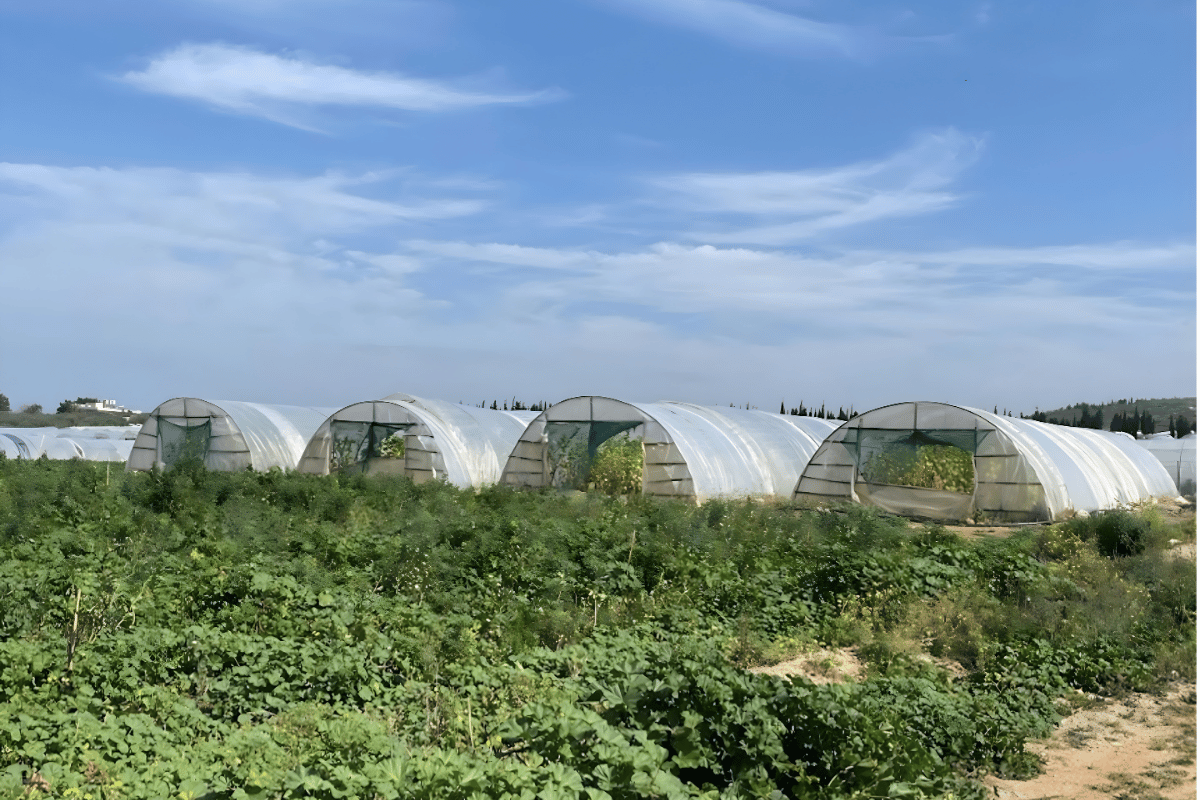
The greenhouse sector plays a crucial role in achieving high and stable crop production, particularly in the Mediterranean Basin, where protected cultivation enables year-round supply and more efficient resource use. Production systems, including those used by smallholder farmers, are largely dominated by low-cost, plastic-covered structures such as walk-in tunnels, multi-span greenhouses, and low tunnels. These systems reflect variations in investment capacity, production intensity, and access to basic climate-control tools (FAO, 2024).
Greenhouse systems have a dual relationship with climate change. They contribute to greenhouse gas emissions while remaining highly vulnerable to climatic shifts (Fanourakis et al., 2025). Historically, the Mediterranean climate was relatively mild and predictable, with less frequent and less intense extreme weather events. Today, however, growers face increasing challenges, including rising temperatures, water scarcity, and more frequent extremes such as strong winds, heavy rainfall, frost events, and sudden heat waves. These changes, both direct and indirect, affect greenhouse microclimates and crop productivity.
Understanding these impacts requires a detailed examination of the practical challenges they create in greenhouse systems. This article focuses on how these pressures translate into real-world constraints on crop production and management. Particular attention is given to smallholder farmers, for whom climatic stress often results in immediate technical and economic challenges.
Rising temperatures and heat waves
Starting with the most prominent climatic shift, rising temperatures and heat waves pose significant challenges, including reduced flower set and increased pest occurrence. Smallholder farmers must adapt through a range of strategies depending on their available resources. High-investment options include upgrading from single-tunnel to multi-span greenhouse structures (ILO, 2022), or further enhancing them with adaptive features such as ventilation fans, which in turn require a reliable energy source. Lower-cost measures may involve passive cooling methods such as using simple openings to improve ventilation or installing insect-proof nets to limit increasing insect populations. However, the choice between these two options can be contradictory, as the use of insect-proof nets may reduce natural aeration. All these tools require specific skills to be used effectively, just as pesticides are only efficient, safe, and sustainable when applied correctly.
The increasing frequency of heat waves also makes markets more unpredictable. Some crops become abundant during periods when they were previously scarce, leading to price drops and disrupting farmers' market expectations. Planting schedules have significantly shifted in response to these environmental conditions, as farmers adjust their cropping calendars to cope with changing temperature patterns and seasonal constraints. Among all climate-induced stressors, elevated temperature emerges as the primary constraint on Mediterranean greenhouse productivity. Heat stress, particularly when combined with increased vapour pressure deficit, disturbs reproductive processes, accelerates physiological disorders, and amplifies oxidative stress in key crops such as tomato, cucumber, and sweet pepper.
Water scarcity and excess rainfall
Beyond temperature-related stress, water availability represents another critical constraint. Water scarcity is becoming increasingly widespread, affecting areas where farmers were previously well-established. In some cases, this may force relocation. In others, farmers must develop adaptation systems, such as sacrificing part of a planting cycle or investing in rainwater collection units that were not previously necessary. Broader sustainable measures, including improving soil structure and using fertilizers more efficiently, need to be systematically implemented to ensure long-term resilience. Precipitation across the Mediterranean is projected to decline by 10–20% annually, with the most severe impacts concentrated in southern Europe and the eastern Mediterranean during summer. Combined with increased evapotranspiration, this will magnify water scarcity and compromise irrigation sustainability for greenhouse operations.
Conversely, heavy rainfall events are also becoming more frequent, leading to water accumulation in and around greenhouse fields. Excess water can infiltrate the soil inside greenhouses, causing root damage and negatively affecting crop growth. This increases both risks and costs for farmers, who may need to install drainage systems that were previously unnecessary. These investments are often made for events that occur only occasionally, or, in contrast, may become so intense that existing drainage systems are no longer sufficient.
Wind and frost as structural threats
In addition to heat and water-related challenges, structural and physical stressors such as wind and frost further complicate greenhouse management. Strong winds require stronger greenhouse structures, costly reinforcements, or innovative solutions that are not always familiar to all farmers. Very strong winds can damage structures, polyethylene covers, and the crops underneath. These issues need to be addressed as quickly as possible to minimise losses, often forcing farmers to take risks during extreme weather to protect whatever they can.
Frost is another major challenge, testing farmers' endurance and decision-making capacity. If not managed properly, frost can completely destroy all crops in a greenhouse in a single early morning event. During cold nights, farmers may spend the entire night in their fields monitoring conditions and deciding whether to activate overhead sprinklers for frost protection. Sometimes the sprinklers are necessary, while at other times they are not. This work is always exhausting and significantly complicates daily farm operations.
The complexity of adapting to multiple stresses
Climate change is not a single event but a series of extreme and variable conditions that farmers must adapt to. The challenge lies in the fact that each climatic factor requires a different adaptation strategy or management step. This creates a complex management problem where costs must be carefully considered and priorities set to achieve the best possible trade-offs.
Greenhouse farmers must decide how to use limited budgets. Should they pay for heating or frost-protection systems to manage unexpected cold spells, or invest in shading, improved aeration, or even completely new greenhouse structures to cope with intense heat waves? Increasingly, multiple stresses occur within the same season, forcing farmers to balance competing needs that never overlapped before. This is where maladaptation becomes a real risk. A measure taken against one stress can inadvertently worsen another, making the evaluation of climate-smart agriculture options as important as the investment itself.
Adaptation requires not only additional investment and improved management but also the acquisition of new knowledge and the adoption of innovative approaches through cooperative, group-based initiatives. This is why smallholder farmers require support. Their experience and traditional knowledge alone are no longer sufficient to cope with the complexities of climate change. This highlights the need for targeted training, improved weather forecasting, the encouragement of cooperative formation, and effective decision-support tools reinforced by applied research and feasibility studies to minimize losses while maintaining the high productivity that makes greenhouse systems valuable.
References
- Fanourakis, D., et al. (2025). Climate change impacts on greenhouse horticulture in the Mediterranean Basin: Challenges and adaptation strategies. Plants, 14(21), 3390.
- IEMed. (2025). Farming in a hotter climate: Adaptation strategies for a resilient Mediterranean agriculture.
- Food and Agriculture Organization (FAO). (2024). Good agricultural practices for greenhouse vegetable crops: Principles for Mediterranean climate areas. FAO Plant Production and Protection Paper.
- International Labour Organization (ILO). (2022). Results of pilot trials on greenhouse productivity and working conditions with 12 selected farmers in Akkar and the Bekaa.