


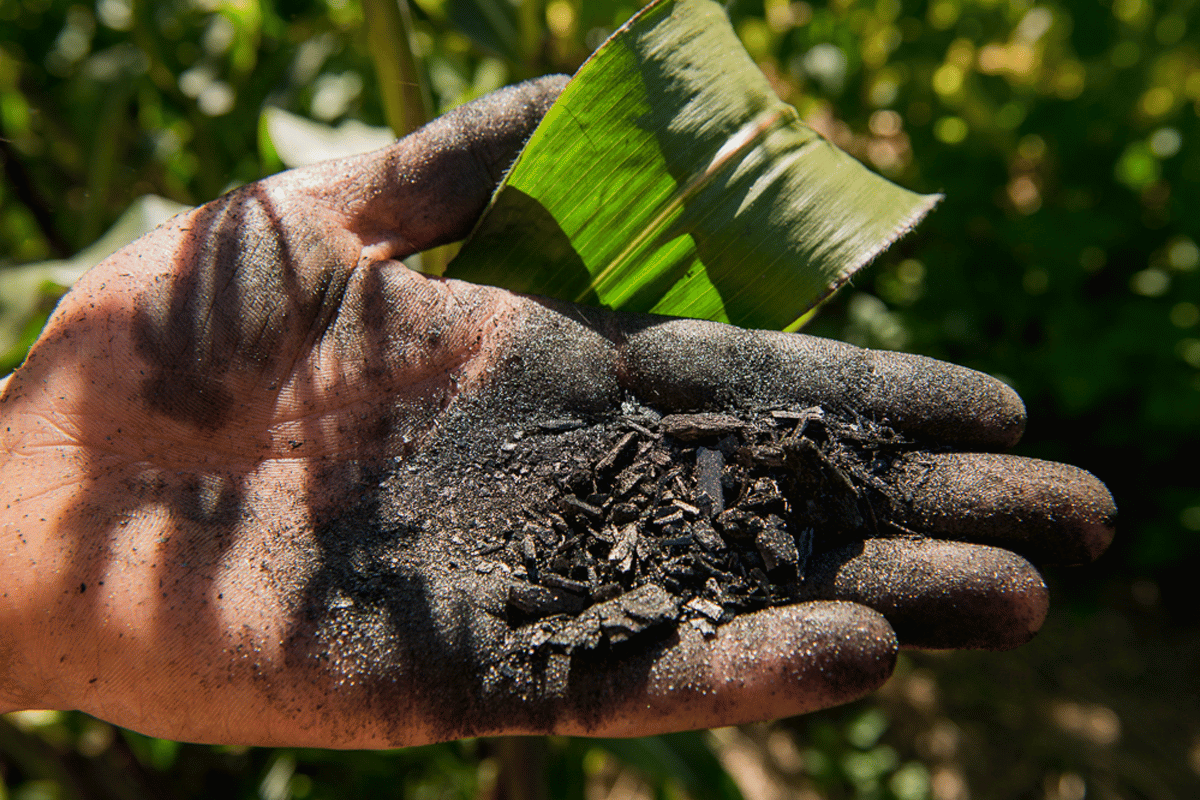
In parts of the forests of eastern Liberia, there is soil that seems to break the rules. By the usual logic of tropical geography, the ground there should be spent, thin, acidic, and washed pale by centuries of hard rain. Instead, patches of it are deep black and crumbling, holding two to three times the carbon of the red earth around it. The Loma and Mande farmers who tend it have been making that soil on purpose for at least seven hundred years, working charred wood, ash, bones, and kitchen waste into the ground until worn-out land comes back to life. The finding comes from years of fieldwork by anthropologists at Sussex and soil scientists at Cornell, who lived in these villages to learn how it was done.
Soil scientists have a name for these patches: African Dark Earths. For most of the last century they had no name at all, because the outside world assumed they did not exist. The famous black earth, terra preta, was thought to belong to the Amazon, a one-off product of pre-Columbian skill. Then researchers found the same thing across Ghana, Guinea, Sierra Leone, and Liberia. Farmers in West Africa had been building carbon-rich soil for centuries. The modern version of what they were making by hand now goes by another name: biochar.
What biochar actually does
Biochar is straightforward once the jargon is stripped away. You heat crop waste, the husks, cobs, prunings, and shells, in a low-oxygen fire, and instead of ash you get a stable, porous carbon that lasts in the soil for decades. Worked into the ground, it behaves like a reef for microbes. It holds water, it holds nutrients that would otherwise wash straight through, and on acidic soil it acts like a gentle lime, nudging the pH up toward something crops can use. These are the same functions that lime, compost, and biochar perform as soil amendments, and the effect is largest exactly where African soil is weakest.
The most authoritative global review, by Jeffery and colleagues in 2017, pulled together 1,125 field comparisons and found an average yield gain of about 13% from adding biochar. That modest average hides a split. In temperate soils, which are mostly moderate in pH and already fertile, biochar did little or nothing. In tropical soils, the low-nutrient, acidic kind that covers much of sub-Saharan Africa, yields rose by roughly 25%, and the effect came mainly from biochar's liming action and its ability to hold water and nutrients.
A more recent meta-analysis focused on acidic soils found an even larger average yield gain, around 38%, in tropical acidic soils in the first few years after application, though the benefit is smallest on the most strongly acidic soils below pH 5. The global average understates the African case because it is dragged down by the temperate soils where biochar was never likely to help.
One honest caveat before going further. Biochar is not free, whatever the feedstock costs. Turning a heap of maize cobs into char takes labour, and it burns biomass a household might otherwise use for cooking or animal feed. The gain is real, and so is the trade-off, and any farmer weighing it deserves to hear both sides.
Africa has a soil crisis that rarely makes the news
Roughly 65% of arable land in sub-Saharan Africa is degraded, and the region loses an estimated four billion dollars a year in soil nutrients, leached and eroded and mined out crop after crop with little put back. Fertiliser use tells the same story: sub-Saharan farmers apply well under 20 kg of nutrients per hectare, against a global average closer to 135 kg, not for lack of wanting it, but because the bag often costs more than the harvest can justify. The result is a wide gap between what fields grow and what they could.
Set that against who is doing the farming. Sub-Saharan Africa has around 33 million smallholder farms. They are roughly 80% of all farms in the region, and in some countries they grow up to 90% of the food. Most work one or two hectares, most depend on rain rather than irrigation, and most have never had a soil test. This is not a niche. It is the backbone of how the continent eats.
Biochar fits that backbone closely: sour, tired soil, no money for fertiliser, and crop waste piling up at every harvest. The raw material is already sitting on the farm.
What happens when farmers actually use it
The African field evidence has grown much stronger in the past few years, and it now uses doses real farmers can manage.
In northern Ghana, trials across the 2023 and 2024 seasons paired biochar with compost and a modest amount of chemical fertiliser. The combination lifted maize grain yield by 106% in the first year and 127% in the second against untreated plots, more than double. It is worth being precise about why. That result came from biochar plus compost plus fertiliser working together, not biochar alone. Biochar was the sponge that made the other two work harder and linger longer in the soil. On its own it delivers the 13-to-25% story above. In combination it becomes a multiplier, and for a farmer already making compost, that distinction is the whole point.
The human side is just as telling. In Kobina Ansa, in Ghana's Central Region, a project trained 100 smallholder sweet-potato farmers who had never used biochar. Within a single season all of them had adopted it, and both yields and revenue rose. When a Kenyan team wanted realistic numbers, they built their char from coconut shells, coffee husks, and maize cobs, the exact waste a household already has to hand. The farmers, again and again, turn out not to be the obstacle.
What is actually holding biochar back
If the science is this good and the farmers this willing, why is biochar not everywhere? Sub-Saharan Africa produces under 5% of the world's biochar and uses only about a quarter of the crop waste it could. The problem is not agronomy. It is the surrounding system.
The barriers show up in study after study, and they rhyme. Farmers do not know biochar exists, or do not yet trust it. Extension services are thin or missing. Credit is hard to get. Land tenure is often insecure, and few will invest in a soil improvement that pays back over years when they cannot be sure they will farm the same plot next season. Good pyrolysis equipment costs money most households do not have. And most African governments have no biochar policy at all, largely because no one has explained it to them.
Carbon finance could change this. Biochar locks carbon away in a form that is measurable and durable, and credits trade at roughly $50 to $150 a tonne, potentially enough to pay a farmer to make char whether or not the yield gain alone justifies the effort. The difficulty is verification. Proving to a carbon registry that a smallholder really buried two tonnes of carbon is fiddly and expensive. The workaround gaining ground is a hub-and-spoke model: one central pyrolysis unit serving every farm within 50 to 100 kilometres, standardising quality and handling the paperwork no individual farmer can.
Which crops should Africa prioritise
There are two answers, and they point the same way.
Lead with maize. It is the continent's keystone cereal, eaten at up to 85 kg per person a year across eastern and southern Africa. It grows on precisely the acidic, degraded soils where biochar performs best, and it carries the strongest African trial evidence. For food security at scale, maize is the mass play, with cassava and yam, the great root staples, close behind on the same sour ground.
Then use high-value crops to make the economics work. The biggest percentage gains in the global data do not come from cereals at all. They come from oil crops, near 37%, and vegetables, near 28%. Those are the crops that put cash in a farmer's hand and make the upfront work of building char worth doing. Staples feed the household, and horticulture pays for the effort.
An old technology, not a new one
There is a clear irony running through this. The rich world spent years treating biochar as a new climate technology, offering it to Africa as though the continent had something to learn. But the farmers of the Upper Guinean forest were building black earth before the word pyrolysis existed. What looks like a technology transfer is really a return to something already known.
That reframes the real task. The work ahead is less about convincing African farmers to accept something foreign and more about helping them scale up what their ancestors already invented, with training, with finance, and with a carbon market willing to pay for the carbon they have long known how to bury. Thirty-three million farmers are working tired soil with cheap waste stacked beside them, and the tool to bring that soil back has been in African ground for seven centuries. Whether it scales now depends on attention and money more than on any further proof that it works.
Sources
Jeffery, S., et al. (2017). Biochar boosts tropical but not temperate crop yields. Environmental Research Letters, 12, 053001.
Jeffery, S., et al. (2011). A quantitative review of the effects of biochar application to soils on crop productivity. Agriculture, Ecosystems and Environment, 144, 175-187.
Aurangzeib, M., et al. (2025). Does biochar improve acidic soil physical properties and crop yield under varying climatic and soil conditions? A global comprehensive meta-analysis. Soil Use and Management, 41(2).
Abdul-Aziz, A.-L., Haruna, A., and Baako, A. Y. (2026). Integrating biochar, compost, and chemical fertilizer improves maize yield and soil health in the guinea savannah, evidence from two cropping seasons in Northern Ghana. Scientific Reports, 16, 2210.
Abdul-Aziz, A.-L., et al. (2026). Farmer adoption of biochar, evidence from smallholder sweet-potato growers. Discover Agriculture.
Fairhead, J., and Leach, M. African Dark Earths research. STEPS Centre, University of Sussex.
Soil health challenges in sub-Saharan Africa, status and solutions. Growing Africa.
Food security in Africa, the role of fertilizers. International Fertilizer Association.