


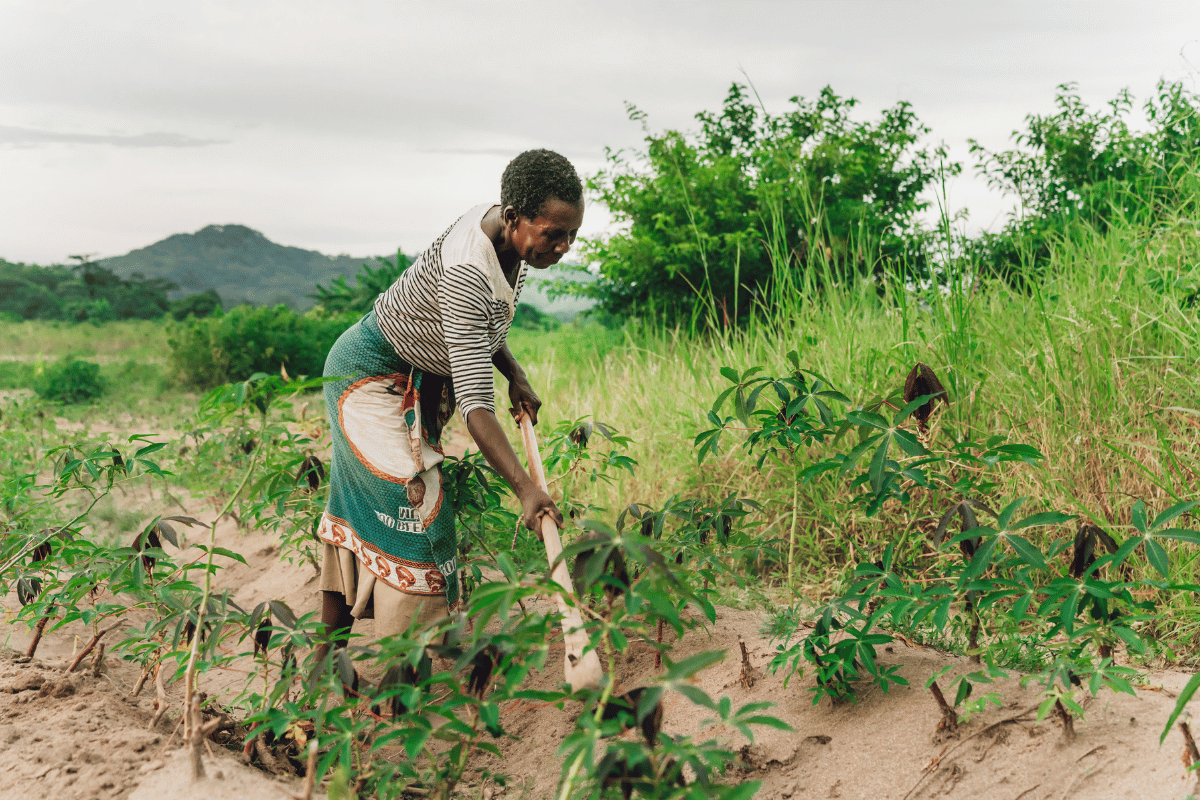
Across many rural communities in South Africa, smallholder farmers face mounting challenges. Rising food prices, climate change, poor soil fertility, limited access to inputs, and unemployment all weigh on household food security. Agroecology offers practical solutions that help farmers produce food sustainably while strengthening local food systems and community resilience.
As an Agroecology Consultant, and Crop Manager and Agroecology Facilitator at the Kidlinks Small Farm Incubator, working with rural communities in the Eastern Cape, I have seen how agroecological practices can transform both farming systems and people's lives. Through training, demonstration sites, and farmer-to-farmer learning, communities are building knowledge, improving production, and gaining better access to healthy food.
Why agroecology matters
Agroecology is more than a farming method. It combines ecological principles, local knowledge, and community participation to create sustainable food systems. Instead of relying heavily on external inputs, agroecology encourages farmers to work with nature by improving soil health, conserving water, increasing biodiversity, and using locally available resources. For many smallholder farmers, this lowers production costs while improving their resilience to drought and extreme weather.
The evidence behind this is growing. A review of 77 cases of agroecological practice in low- and middle-income countries found that crop yields were higher in 63% of the cases that reported them, and that benefits such as greater crop diversity, higher and steadier income, better nutrient regulation, and reduced pest infestation appeared in 70% or more of cases. For a smallholder household, those are exactly the qualities that turn a single harvest into a more secure livelihood.
The crops and conditions farmers work with
In the Eastern Cape, most smallholder households grow a mix of field crops and vegetables. Maize is the staple and the foundation of most plots, while cabbage is the most widely grown and most frequently eaten vegetable. Alongside these, farmers commonly cultivate potatoes, spinach, carrots, butternut, and beetroot. Rainfall across much of the province runs between 800 and 1,200 mm a year, which is enough for productive cropping in good seasons but leaves farmers exposed when the rains arrive late or fall short.
This mix matters for how agroecology is taught. A practice has to earn its place in a real rotation of maize and vegetables, on land where water is the limiting factor in most seasons. Training that ignores this reality does not last, while training that works with it, by building soils that hold moisture and by diversifying what a household grows, tends to take hold.
Learning through demonstration
One of the most effective ways to train farmers is through practical demonstration and participatory learning. Farmers gain a deeper understanding when they can watch a technique in action and then try it themselves. Training activities often cover soil health management, compost production, seed saving, seedling propagation, water conservation, crop diversification, and ecological pest management. Combining theory with hands-on practice helps farmers build confidence and adapt agroecological methods to their own conditions, because they can see the results directly and work out how each practice fits their farm.
What this looks like in the field
Much of my work focuses on helping farmers improve food production and resilience through practical training and demonstration. One example involves building soil health with compost, vermicompost, crop rotation, cover crops, biofertilisers, and activated biochar, which together reduce a household's dependence on expensive external inputs. Through regular demonstrations and farmer-to-farmer knowledge exchange, the farmers I work with have seen improvements in soil structure, moisture retention, crop performance, and overall garden productivity.
Vegetable crops such as spinach, cabbage, beetroot, onions, and kale have shown stronger growth and greater resilience during dry periods. Farmers have also cut their production costs by making their own compost, vermicompost, and nursery seedlings from materials available within the community.
The training goes beyond soil and vegetables. I also promote beekeeping and pollinator conservation, since many rural communities still destroy bee colonies out of fear or a lack of awareness of their role. Encouraging farmers to see bees as partners in food production and biodiversity has become an important part of the work. Alongside this, I run training on worm farming for vermicompost production, on indigenous crops and medicinal plants, and on microgreens for nutrition and income, all of which strengthen household food security and the wider local food system.
What changes when farmers adopt agroecological practices
One of the first changes farmers notice is improved soil quality. Composting, mulching, biochar, and vermicomposting all build fertile soil that holds moisture for longer, which matters most in the dry months. Worm-worked compost is a good example of why these methods appeal to smallholders. It can be produced in roughly half the time of conventional hot composting, it can be applied straight after it is ready, with no months-long wait for it to mature, and its nutrients are held in a readily available form for the plants.
Farmers also begin to reduce their dependence on expensive chemical fertilisers, and many learn to produce their own organic inputs from materials they already have on hand. Where these practices take hold, vegetable production often improves, particularly during dry periods, so families gain better access to fresh, nutritious food while surplus produce can be shared within the community or sold locally. Diversifying what a household grows is one of the most reliable gains. Recent work on diversified cropping found that rotations which include legumes can raise yields by up to 38% and net farm income by close to 20%, while also spreading a household's risk across more than one crop.
Another important change is knowledge sharing. Farmers become teachers themselves, passing skills to neighbours, family members, and community groups. This strengthens local networks and builds more resilient food systems.
Challenges to adoption
Agroecology offers many benefits, but adoption is rarely immediate. Some farmers are used to conventional methods and doubt at first whether agroecological practices can produce enough yield. Others face practical constraints such as limited access to water, fencing, tools, or land. Patience matters, since farmers need time to see results and adapt practices to their own circumstances.
Agroecology also asks for learning and experimentation. Buying a commercial input is simple, but understanding ecological processes and developing new skills takes time and ongoing guidance. Studies of agroecology in smallholder systems make the same point, that the success of any practice depends heavily on local context, so a technique that works on one farm has to be tested and adjusted on the next, not simply copied wholesale. This is why continuous support and follow-up training are essential.
What makes training effective
Through experience, I have learned that good training goes beyond passing on information.
Training has to respect local knowledge. Farmers already hold valuable experience and insight, and when training becomes a dialogue instead of a lecture, participation and learning both deepen.
Practical activities work better than classroom presentations alone, because farmers remember what they do, not only what they hear. The evidence for this kind of hands-on, school-based training is strong. A 2024 study of 517 smallholder farmers in northern Ghana found that taking part in farmer field schools was strongly linked to better climate resilience, more so than most other factors the researchers measured.
Peer learning creates lasting impact. When farmers share their own experiences and solutions with one another, confidence grows and good ideas spread faster.
Ongoing mentorship is critical. Regular visits, follow-up discussions, and chances for farmers to share their progress keep motivation high and support long-term adoption.
Building stronger local food systems
Local food systems grow stronger when communities can produce diverse, healthy food from locally available resources. Agroecology supports this by reducing dependence on external inputs and strengthening local knowledge.
Training farmers in agroecological practices brings benefits well beyond the individual household. Communities improve their food security, protect natural resources, create learning opportunities, and build resilience against economic and environmental pressures. As rural communities continue to face uncertainty, agroecology offers a pathway toward more sustainable and fairer food systems.
My experience at the Kidlinks Small Farm Incubator has shown me that agroecology is about more than growing food. It is about empowering communities, strengthening local knowledge, and creating resilient food systems that can support future generations. When farmers are given the chance to learn, experiment, and share what they know, real change becomes possible, and agroecology can play a significant role in improving food security and rural livelihoods across South Africa and beyond.
Sources
Dittmer, K. M., Rose, S., Snapp, S. S., Kebede, Y., Brickman, S., Shelton, S., et al. (2023). Agroecology can promote climate change adaptation outcomes without compromising yield in smallholder systems. Environmental Management, 72, 333–342.
Pienaah, C. K. A., Antabe, R., Arku, G., and Luginaah, I. (2024). Farmer field schools, climate action plans and climate change resilience among smallholder farmers in Northern Ghana. Climatic Change, 177, 90.
Crop diversification strategies for sustainable agriculture and climate-resilient ecosystems. (2025). Diverse fields for stronger yields. Frontiers in Agronomy, 7, 1746895.
Baiyegunhi, L. J. S., et al. (2022). Profitability of cabbage production by smallholder farmers in the Eastern Cape Province, South Africa. South African Journal of Agricultural Extension.
Wikifarmer. What is vermicompost? How to produce and apply it.