



Many smallholder farmers work hard throughout an entire production cycle and are disappointed by how little profit remains at the end. The cause is usually not effort or commitment. It is the absence of sound agribusiness practice. Producing more is only part of the picture, and success depends just as much on managing costs, cutting losses, and making decisions backed by numbers.
Improving a margin means widening the gap between what the produce earns and what it costs to grow. That comes from raising productivity, controlling expenses, working more efficiently, and marketing more deliberately—small changes in how a farm is run compound into real differences in profitability over a few seasons.
What follows applies whether the enterprise is poultry, crops, livestock, or mixed farming.
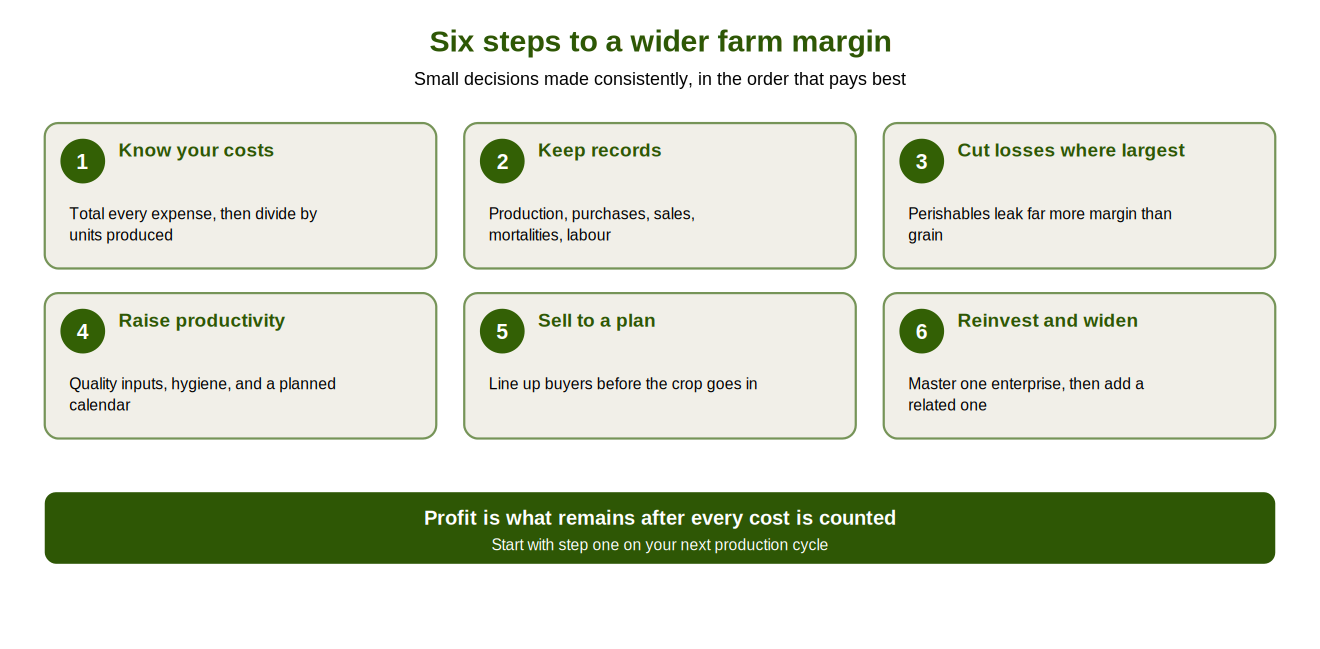
The six steps, in the order that pays best.
Work out your true cost of production
One of the most common mistakes is assuming a sale means a profit. Profit appears only after all costs of producing that unit have been counted.
Keep records of all of it: chicks or seed, feed or fertiliser, medication, labour, transport, fuel, utilities, equipment repairs, and the small incidental costs that get forgotten. At the end of each cycle, divide the total by the number of units produced to get a cost per kilogram, per bird, per crate of eggs, or per bag.
That single figure changes how a farmer operates. It sets a floor under the selling price, provides a basis for negotiating with buyers rather than accepting what is offered, and shows which costs are worth attacking first.
Produce for profit rather than for volume
High output does not always mean high profit. A farmer producing fewer units efficiently can earn more than one who produces a large quantity at high cost.
Choose enterprises with real market demand, avoid spending that does not earn its keep, and work on efficiency. Every decision on the farm can be tested against one question: Does this add to profit, or only to cost?
Raise productivity through better management
Efficient management is the foundation of profitability, because healthy crops and animals convert inputs into saleable product far better than poorly managed ones do.
Plan the production calendar, buy quality inputs, follow recommended practice, maintain hygiene and biosecurity, and check crops or stock regularly. Preventing a problem is almost always cheaper than fixing one.
Buy more shrewdly
Inputs account for a large share of production expenses, so buying well directly protects the margin.
Buy from reputable suppliers, compare prices before committing, and buy in bulk where it makes sense. Joining a farmer cooperative can open up discounts and shared transport costs that are out of reach individually. Cheap inputs that compromise quality are a false economy, because the losses arrive later and cost more.
Cut post-harvest losses where they are largest
This is where a great deal of margin quietly disappears, and the scale differs sharply by product. In Nigeria, losses for grains are estimated at roughly 5% to 20%, while for tubers, fruits, and vegetables, they run as high as 50% to 60%, with the national cost of post-harvest waste put at around 3.5 trillion naira a year. Across sub-Saharan Africa, the FAO estimates that about 37% of food produced is lost between production and consumption.
Those headline figures are worth reading carefully. On-farm storage losses for grain, measured directly, often turn out to be lower than national estimates suggest, and losses tend to concentrate in a minority of households rather than spreading evenly. The practical conclusion is that perishables are usually where the money leaks. A farmer growing tomatoes, peppers, or leafy vegetables has far more at stake in handling and timing than one storing maize.
So harvest at the right moment, handle produce gently, store it in suitable conditions, and package it properly. Where feasible, processing raw produce into products with a longer shelf life and a higher price captures value that would otherwise spoil. Every kilogram kept out of the waste heap goes straight to the margin.
Sell to a plan
Successful farmers know where the crop is going before they plant it. Looking for buyers at harvest usually means accepting whatever price is available on the day.
Identify customers early and build relationships with wholesalers, retailers, processors, restaurants, and consumers. Explore more than one channel, since selling directly to the end user or processing first often returns more than selling into the nearest available market. Understanding seasonal price patterns also shows when to sell immediately and when short-term storage will pay.
Keep accurate records
Record-keeping is what turns farming into a business because it is the only way to know what actually happened, not what it felt like.
Keep records of production, purchases, sales, mortalities, use of inputs, labour, and profit. Reviewing them regularly is what reveals where the operation is strong, where it is weak, and what to change next season. What is not measured cannot be managed well.
Diversify without losing focus.
Diversification spreads risk across multiple income streams, and it works when it is deliberate rather than opportunistic.
A poultry farmer might also produce organic manure, hatch chicks, process chicken, or sell inputs. A crop farmer might process produce or add a complementary livestock enterprise. The sequence matters: establish one profitable enterprise, learn it properly, then expand into related businesses that reinforce the first.
Use technology and information
Timely information is now part of running a farm well, and a mobile phone covers most of what a smallholder needs. It can track market prices, deliver weather updates, teach improved production techniques, connect a farmer to buyers, and advertise produce through social media. Even simple digital tools sharpen business decisions.
Keep learning
Agriculture keeps changing, through new technology, better methods, shifting market demand, and new disease pressure.
Attend workshops and training, join a farmer association, take advice from extension officers, and learn from farmers who are further along. Knowledge compounds faster than most other investments on a farm.
The mistakes that most often cost money
Several avoidable errors keep margins low: weak record-keeping, delayed disease control, overstocking, buying substandard inputs, pricing emotionally rather than from cost, ignoring what the market actually wants, and starting a cycle without a production budget. Spotting these early is what prevents them becoming losses.
An action plan to start with
Improvement starts with a few consistent actions. Calculate the production cost for your next cycle. Record every expense and every sale. Look at your largest costs and find the ones that can come down without damaging output. Build a marketing plan before production starts, and line up buyers you can rely on. Then commit to learning one new agribusiness skill each month and applying it.
Building a profitable farm takes more than hard work, because it means running the farm as a business. Farmers who know their costs, use resources efficiently, keep losses down, maintain records, and market deliberately are the ones who end a season with something to show for it. The gains rarely come from a single dramatic change. They come from many sound decisions made consistently.
Sources
Post-harvest losses of farm produce in Nigeria. African Journal of Food, Agriculture, Nutrition and Development.
Reducing post-harvest losses in southwest Nigeria, policy, practice, and promise. DAWN Commission.
World Bank. Is post-harvest loss significant in sub-Saharan Africa?
FAO. Guidelines on the measurement of harvest and post-harvest losses.